
This cost guide is a companion to our main 2025 NHIS Q&A guide for foreign English teachers in Korea.
If you are planning to teach English in Korea, you have probably heard that Korean health insurance (NHIS) is “cheap and good” – but what does that actually mean in real money?
This guide breaks down Korean health insurance costs in 2025 for foreign English teachers, using simple salary examples and real-world situations.
1. Quick Overview: How Much Will I Pay for Health Insurance in Korea?
Most foreign English teachers in Korea are enrolled as employee insured (through their school or employer).
In that case, your health insurance cost in 2025 looks like this:
- You pay about 4% of your gross monthly salary.
- Your employer pays roughly the same amount on their side.
- This includes the main National Health Insurance (NHI) + a small amount for Long-Term Care Insurance.
There is no big annual deductible like in many US-style plans.
You just pay your monthly premium and small co-pays when you visit the doctor or hospital.
2. How Korean Health Insurance Premiums Are Calculated in 2025
2.1. The Basic Formula (Employee Insured)
If you are employed by a Korean school, hagwon, or company and registered as an employee insured person, your premium is based on your monthly salary.
In simple terms:
- The government sets a percentage rate for National Health Insurance (NHI).
- That rate is applied to your salary to find the total premium.
- The total premium is then split roughly 50/50 between you and your employer.
On top of this, a smaller extra charge is added for the Long-Term Care Insurance program, which helps fund care for the elderly.
2.2. Why Your Paystub Shows Around 4%
When you look at your Korean paystub, you will usually see:
- One line for National Health Insurance (NHI)
- One line for Long-Term Care Insurance (LTCI)
Combined together, these usually work out to around 4% of your gross salary.
Your school then pays roughly the same amount behind the scenes.
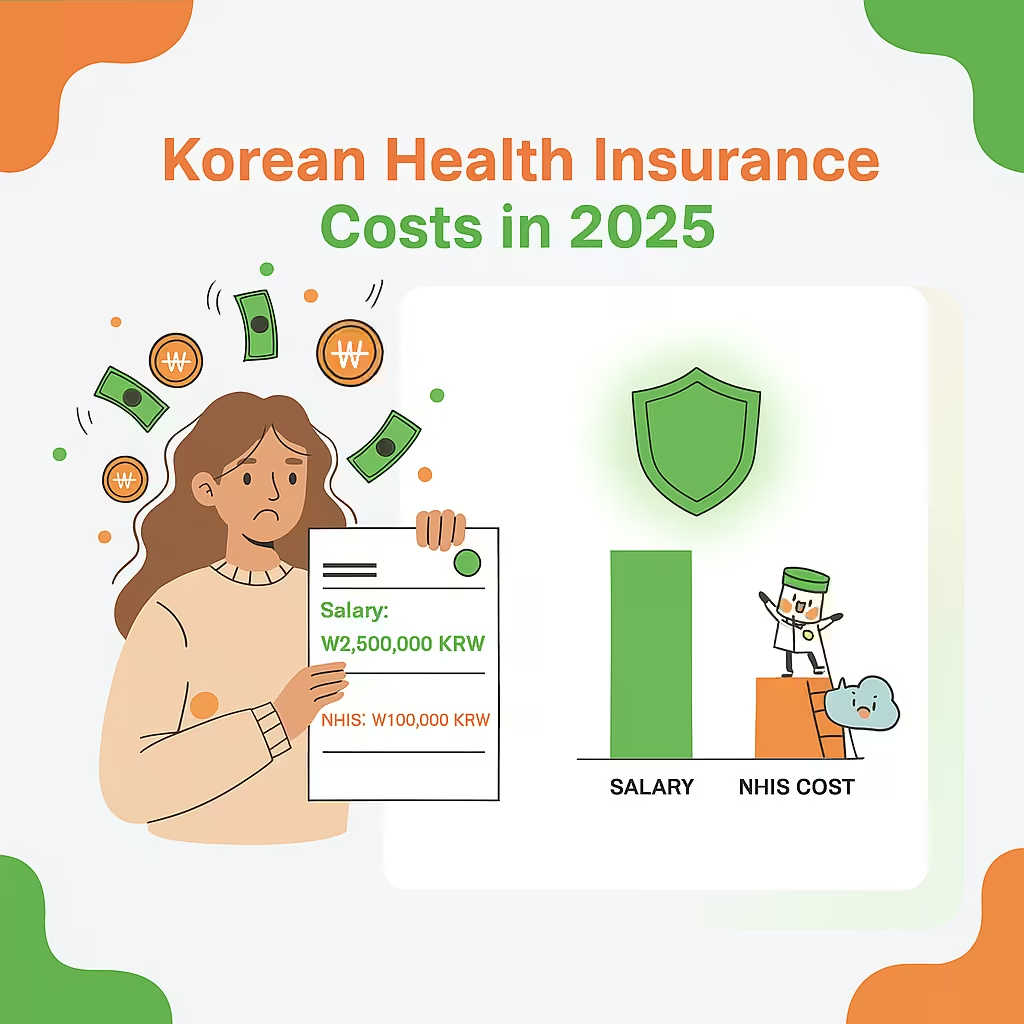
So if your monthly gross salary is ₩2,500,000, your share of health-related deductions is roughly:
- ≈ ₩100,000 per month for NHI + LTCI
- That is approximately $75 USD (depending on exchange rates).
This is your regular monthly cost while you are employee insured and fully enrolled.
3. Real Numbers: Example Monthly Costs by Salary
To make things less abstract, here are some example salary levels that are common for foreign English teachers in Korea, and what your monthly health insurance cost might look like.
3.1. Salary: ₩2,300,000 per month
This is on the lower side but still common for some hagwon or smaller city positions.
- Estimated health deduction (your share): around ₩92,000 per month
- That is roughly $70 USD.
For this amount, you are fully covered under Korean National Health Insurance and pay only small co-pays at clinics and hospitals.
3.2. Salary: ₩2,500,000 per month
A very typical starting salary for many E-2 visa positions.
- Estimated health deduction (your share): around ₩100,000 per month
- That is roughly $75 USD.
Many teachers are surprised how cheap this is compared to what they would pay for health insurance in their home country for similar coverage.
3.3. Salary: ₩2,700,000 per month
A slightly higher salary, common in some metropolitan areas or more experienced roles.
- Estimated health deduction (your share): around ₩108,000 per month
- That is roughly $80–$85 USD.
The increase is proportional – you still pay around 4% of your salary.
3.4. Salary: ₩3,000,000 per month
A common number for higher-paying hagwons, experienced teachers, or certain public school jobs.
- Estimated health deduction (your share): around ₩120,000 per month
- That is roughly $90–$95 USD.
Even at this salary, your health insurance cost is still modest compared to typical premiums in countries like the United States, especially considering that your family can usually be added as dependents without raising your premium.
3.5. Important Notes About These Examples
- These are rough 2025 estimates for employee insured foreign teachers.
- The exact number on your paystub may differ slightly based on official rate changes and employer reporting.
- Your school also pays roughly the same amount on top of your salary, but you do not see this on your paystub.
4. Why Your First Health Insurance Deduction May Be Much Higher
4.1. The “First Paycheck Shock” Explained
Many new teachers panic when they see their first NHIS deduction because it looks much larger than 4% of their salary. In most cases, this is not a fine or penalty – it is simply retroactive billing.
Here is a typical scenario:
- Your Alien Registration Card (ARC) is issued on October 8.
- Your official NHIS coverage begins on that date.
- Your first paycheck comes on October 25.
That first deduction may include:
- The premium for October 8–31 (back-billed for the partial month), and
- The premium for November (pre-paid).
So instead of seeing ~₩100,000 deducted, you might see close to ~₩200,000.
From the second month onward, the deduction usually returns to a normal level.
4.2. How to Check If the Amount Is Reasonable
If your first deduction looks very high, you can:
- Ask your school’s admin office for a simple breakdown (which months are included).
- Call the NHIS English helpline with your ARC number and ask them to confirm your contributions.
- Compare the amount to roughly 4% of your monthly salary multiplied by the number of months being billed.
As long as you are employee insured and your school is correctly registered, a large first deduction is usually just a timing issue, not a sign of a problem.
5. Employee Insured vs Local Insured: Who Pays What?
5.1. Employee Insured: The Standard Case for E-2 Teachers
As a full-time foreign English teacher at a school or hagwon, you should normally be registered as an employee insured person.
In this case:
- Your premium is based on your salary.
- The total premium is split roughly 50/50 between you and your employer.
- Your spouse and children can usually be added as dependents without raising your premium.
This is the most protective and most affordable option for most teachers.
5.2. Local Insured: When You Do Not Have an Employer
“Local insured” (지역가입자) is usually for people who do not have an employer in Korea, such as:
- Self-employed people
- Unemployed people between jobs
- Some long-term residents on visas that are not tied to a single employer
If you are local insured, your premium is based on a mix of factors such as:
- Reported income
- Property or assets
- Other financial information
For many full-time foreign teachers, local insured premiums can actually be more expensive than employee insured premiums, because there is no employer to share the cost.
5.3. Red Flags to Watch Out For
If you are working full-time for a school and they:
- Do not enroll you as employee insured, or
- Tell you to sign up as local insured and pay the full premium yourself,
this may be a sign that the school is trying to avoid paying its share of NHIS.
In that case, it is worth asking questions and, if necessary, getting advice before agreeing.
6. How Korean Health Insurance Costs Compare to the U.S. and Other High-Cost Systems
To understand the real value of paying around 4% of your salary for Korean health insurance,
it helps to compare it to typical costs in high-cost healthcare systems like the United States.
6.1. Monthly Premiums
In Korea, a foreign English teacher earning ₩2,500,000 per month might pay about ₩100,000 per month (around $75 USD) for NHIS and long-term care.
In the United States, the worker’s share of an employer family health plan can easily be $500–$600 per month or more, even before co-pays and deductibles.
6.2. Deductibles and Out-of-Pocket Maximums
Korea’s NHIS does not use a big annual deductible.
You pay your monthly premium and then pay co-pays (a percentage of the already discounted bill) when you use medical services.
In many U.S. plans, you may have to pay $1,000–$10,000+ in deductibles and out-of-pocket costs, even if you are insured.
6.3. Annual “Safety Net”
Korea has an annual co-payment ceiling based on your income.
Once your co-pays in a year reach that ceiling, NHIS covers 100% of further covered costs.
In many other countries, there is no such clear ceiling, especially if you are uninsured.
7. Simple Budgeting Checklist for New English Teachers in Korea
To keep your finances under control and avoid surprises, here is a simple checklist for budgeting your Korean health insurance costs in 2025:
- Plan for around 4% of your gross monthly salary to go to NHIS + long-term care.
- Expect your first deduction to be higher if it includes retroactive billing.
- Remember that your employer is paying about the same amount on top of your salary.
- If you have a spouse or children, understand that they can usually be added as dependents with no extra premium.
- Keep some extra savings for co-pays, especially in the first months while you are adjusting.
For a full explanation of how Korean health insurance works – including enrollment, coverage, co-pays, dental care, mental health, and family coverage – see our main guide: “Your 2025 Q&A Guide to Korean Health Insurance (NHIS) for Foreign English Teachers.”