


Working in Korea · D-10 Job-Seeker Visa
When your E-2 teaching contract ends and you want to stay in Korea to line up your next job, the D-10 job-seeker visa is the bridge. It lets you remain legally while you search — but it comes with real limits, and the rules changed in October 2025. This guide walks through the pathway from an ending E-2 to a new one, with the current stay lengths, fees, and documents. Written by OK Recruiting, a Korea-based teacher recruiter (since 2006).
The short version
- The D-10 lets you stay in Korea to look for work; you cannot teach or hold a regular job on it (internships aside).
- A 2025 reform raised the general D-10 to up to 3 years — but that headline is for high point-scorers and Korean-university graduates. A former E-2 teacher using the career exemption gets it in 6-month grants, up to 1 year total.
- Switching E-2 → D-10 → back to E-2 each costs ₩100,000; the E-2 medical check is no longer an HIV test (removed 2017).
- As of 2026 Rules follow the Ministry of Justice revision effective 29 Oct 2025.
E-2 ends
Contract finished or not renewed
Apply for D-10
Change status before your E-2 expires
Job search
Find your next school (no teaching yet)
Back to E-2
New contract → switch to E-2
What the D-10 Is (and the October 2025 change)
The D-10 (구직, gujik) is Korea’s job-seeker visa: it authorizes you to stay and look for qualifying work, not to do the work itself. On 29 October 2025 the Ministry of Justice loosened the general rules — grants moved from 6-month to 1-year increments, and the overall cap rose from 2 to 3 years. The catch for teachers: those longer terms are tied to the points system and to Korean-university graduates. If you’re a former E-2 teacher using the career exemption (below), you’re on a shorter track.
Which Track Are You On?
How long you can stay — and whether you face the points test — depends entirely on your situation:
| Your situation | Points test? | Maximum total stay |
|---|---|---|
| Former E-2 teacher (or other E-1–E-7) whose contract ended | Exempt (career track) | 1 year, in 6-month grants |
| Points applicant scoring 60–79 | Required (60+ of 190, incl. 20 basic) | 1 year |
| Points applicant scoring 80+ | Required | Up to 3 years |
| Recent graduate of a Korean university | Exempt | Up to 3 years |
Applying for the D-10 From Your E-2
You change status at a HiKorea immigration office, ideally before your E-2 expires. Typical documents:
- Passport and Alien Registration Card (ARC)
- Completed application form + one photo
- A job-search activity plan (구직활동계획서)
- Proof of your address in Korea
- Evidence your previous contract ended (career-exemption track)
The change-of-status fee is ₩100,000, plus ₩35,000 (cash) if a new ARC is printed. The official processing standard is 15 days (up to 60 if extra review is needed) — in practice allow two to four weeks, and book your HiKorea appointment early, because slots in Seoul and Busan can take weeks to open.
What You Can — and Can’t — Do on a D-10
You can
- Stay legally and search for a job
- Attend interviews and demos
- Do an internship in a professional (E-1–E-7) field, with permission — up to one year at a single company
- Extend within your track’s cap
You can’t
- Teach at a hagwon or school — that needs an E-2
- Hold any regular paid job
- Rely on a part-time work permit — that’s only for Korean-university graduates who never held an E-series visa, so former E-2 teachers don’t qualify
Switching Back to E-2
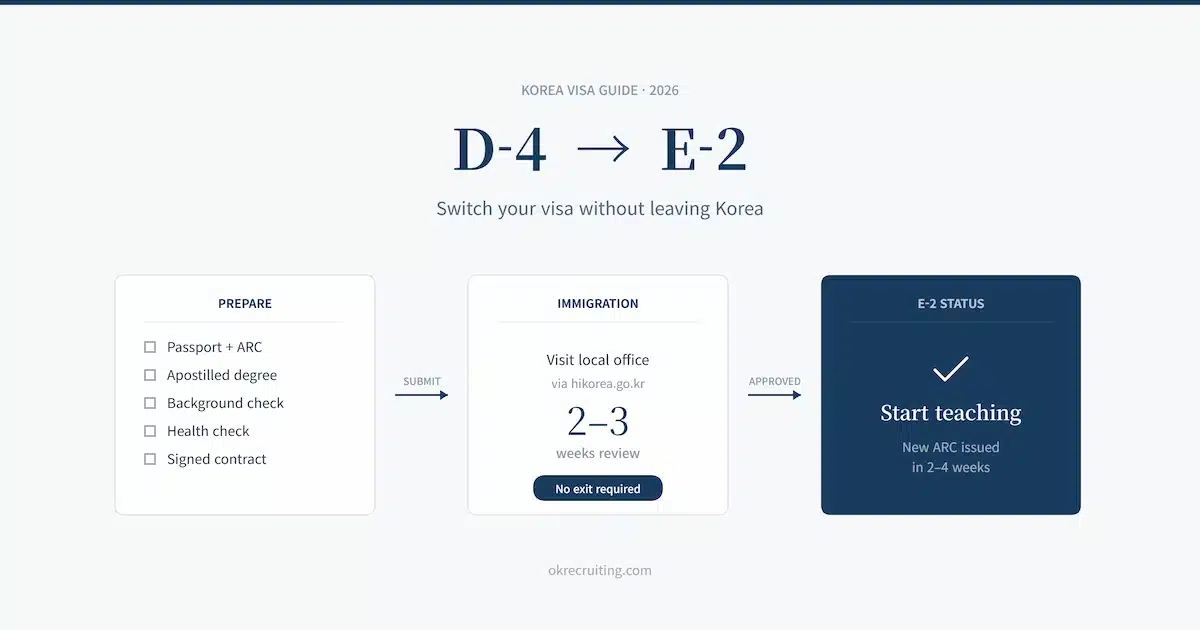
Once you sign a new teaching contract, you change status from D-10 back to E-2 (fee ₩100,000). You’ll re-submit the core E-2 documents — signed contract, apostilled degree and criminal background check — and a fresh employment medical check.
The E-2 medical check (2026)
Korea abolished the mandatory HIV test for E-2 teachers in 2017. The current employment health check, done at a Ministry-designated hospital, covers a drug screen (methamphetamine, cocaine, opiates, and cannabis) and a chest X-ray for tuberculosis, plus standard physical items. It costs about ₩100,000, is submitted sealed, and must be issued within 3 months. Note: a positive cannabis result can lead to visa denial even if cannabis is legal in your home country.
Costs and Timeline at a Glance
| Item | Fee |
|---|---|
| Change of status, E-2 → D-10 | ₩100,000 |
| New Alien Registration Card (if issued) | ₩35,000 (cash) |
| D-10 extension | ₩60,000 |
| Change of status back, D-10 → E-2 | ₩100,000 |
| E-2 employment medical check | about ₩100,000 |
Processing for a change of status is officially 15 days (up to 60 if reviewed). Book appointments before your current status expires.
Frequently Asked Questions
Can I work while on a D-10 job-seeker visa in Korea?
No regular employment is allowed on a D-10 visa. As of the Ministry of Justice revision effective October 29, 2025, D-10 holders may do internships in professional (E-1 to E-7) fields with immigration permission, for up to one year at a single company. Part-time work permits exist only for graduates of Korean universities who have never held an E-series visa, so former E-2 teachers do not qualify. Teaching at a hagwon or school on a D-10 is illegal; you need an E-2 visa first.
How long can a former E-2 teacher stay in Korea on a D-10 visa?
As of 2026, former E-1 to E-7 professionals (including E-2 English teachers) who switch to a D-10 under the career exemption receive it in 6-month grants, up to a total of 1 year. The longer terms you may see quoted — up to 3 years — apply to Korean-university graduates and applicants scoring 80 or more on the points system, not to the standard E-2 leaver track.
Does switching from an E-2 to a D-10 visa require Korea’s points evaluation?
No. Under the guidelines current in 2026, foreigners who held a professional E-1 to E-7 visa (including E-2 teachers) and could not renew their contract before expiry are exempt from the D-10 points evaluation. The trade-off is a shorter stay of one year total. Applicants without that exemption must score at least 60 out of 190 points, including 20 points from the basic age and education items.
Does the E-2 visa medical check in Korea still include an HIV test?
No. Korea abolished the mandatory HIV test for E-2 visa holders in July 2017. As of 2026 the employment health check — required when switching from a D-10 back to an E-2 — covers a drug screen for methamphetamine, cocaine, opiates, and cannabis at a designated hospital, plus a chest X-ray for tuberculosis and standard physical items. It costs about 100,000 KRW and must be submitted sealed, issued within 3 months.
How much does the D-10 visa cost in Korea in 2026?
The change-of-status fee is 100,000 KRW, both for switching from an E-2 to a D-10 and later from a D-10 back to an E-2, plus 35,000 KRW in cash if a new Alien Registration Card is issued. Extending a D-10 costs 60,000 KRW. Budget roughly another 100,000 KRW for the E-2 medical check when you land a job.
How long does D-10 processing take in Korea?
The official processing standard for a change of status is 15 days, extendable to up to 60 days if additional review is needed. In practice, allow two to four weeks depending on the office and season, and book your HiKorea appointment well before your E-2 expires, since appointment slots can take weeks to open in Seoul and Busan.
Disclaimer: Immigration rules change and individual cases vary; this guide is current as of 2026. Always confirm the requirements for your situation with HiKorea (1345) or a licensed administrative scrivener before acting.
On a D-10 and looking for a teaching job?
OK Recruiting matches qualified teachers with verified schools — 100% free, and we guide you through the E-2 visa switch. Since 2006.
View English Teaching Jobs in Korea Start Your Free Application