Moving to Korea to teach English and worried about health insurance costs?
This guide is written just for foreign English teachers in Korea (E-2 and similar visas).
Read it like a simple Q&A: one question at a time, clear answers, no legal jargon.
The short version: Korea’s National Health Insurance Service (NHIS) is mandatory, but it’s also one of the most affordable and generous systems you’ll probably ever use.
1. Before You’re Covered: Enrollment & the “Insurance Gap”
Q1. What is the NHIS, and why do I have to join?
The National Health Insurance Service (NHIS) is Korea’s public health insurance system.
If you stay in Korea for six months or longer, you are legally required to join.
- It’s a government program, not a private company plan.
- For most English teachers, enrollment is not optional.
- If you do not pay your premiums, it can affect your visa renewal.
Q2. I’m an E-2 teacher. How will I be enrolled?
If you are employed by a Korean school, hagwon, or company, you are usually classified as an “Employee Insured” (workplace-based insured person).
This is the best situation for you.
- Your employer is legally required to register you with NHIS.
- They submit the paperwork. You normally do not register yourself.
- Your monthly premium is shared 50/50 between you and your school.
Q3. When does my NHIS coverage actually start?
This is the #1 confusion for new teachers.
Your coverage does not start:
- Not on the day you land in Korea
- Not on the day you sign your contract
Your NHIS coverage starts on the date your Alien Registration Card (ARC) is issued and registered in the system.
That ARC date is your official NHIS start date.
Q4. What is the “insurance gap” everyone talks about?
The “insurance gap” is the risky period between:
- Arriving in Korea, and
- The day your ARC is issued and your NHIS coverage starts.
Here’s a realistic timeline for many new teachers:
- Week 1: Arrive in Korea, get a phone, book your immigration appointment.
Status: UNINSURED - Week 2–3: Visit the immigration office and apply for your ARC.
Status: UNINSURED - Week 4–7: Waiting for ARC to be processed and issued.
Status: UNINSURED - Week 8: Your ARC is issued and NHIS coverage is activated from this date.
Status: COVERED - Week 10: Your NHIS card arrives in the mail (you can usually use your ARC number earlier).
Status: COVERED
During the gap, if you have a serious accident or emergency, you pay
100% of the medical bill without NHIS discounts.
Q5. How do I protect myself during the insurance gap?
The solution is simple but very important:
buy private travel or short-term health insurance that covers your first
2–3 months in Korea.
- Buy it before you leave or as soon as you can.
- Make sure it covers emergencies and hospital care in Korea.
- Use it until your NHIS starts from your ARC date.
2. Monthly Premiums: How Much Comes Out of My Paycheck?
Q6. As an employee, how is my monthly NHIS premium calculated?
Your health insurance premium is based on a percentage of your gross (pre-tax) salary.
As of 2024/2025, the total standard rate for National Health Insurance is about 7.09% of your salary.
The good news: this amount is split equally between you and your employer.
- You pay: about 3.545% of your salary
- Your school pays: about 3.545% of your salary
Q7. Why is my deduction a bit higher than 3.545%?
On your paystub, you’ll usually see a deduction that looks closer to 4.0% of your salary.
That’s because you are paying for two things:
- National Health Insurance (NHI) – the main health insurance
- Long-Term Care Insurance (LTCI) – a small extra amount for elderly care
In 2025, the LTCI rate is about 13.14% of your NHI premium, which ends up around 0.46% of your salary.
So your total health-related deduction is roughly:
- ≈ 4.0% of your gross monthly salary (your share)
- Your employer pays about the same amount on their side.
Q8. My first NHIS deduction is huge. Did I get fined?
Probably not. This is usually just “retroactive billing”.
Example:
Your ARC (and NHIS coverage) starts on October 8, but your first paycheck is on October 25.
That paycheck may include:
- Premium for October 8–31 (back-billed), plus
- Premium for November (pre-paid).
It can feel like a big surprise, but it’s a one-time catch-up.
From the next month, your deduction should look like a normal ~4% of your salary.
Q9. Roughly how much will I pay each month?
Here are some simple 2025 estimates for your share of the premium (about 4.0% of salary):
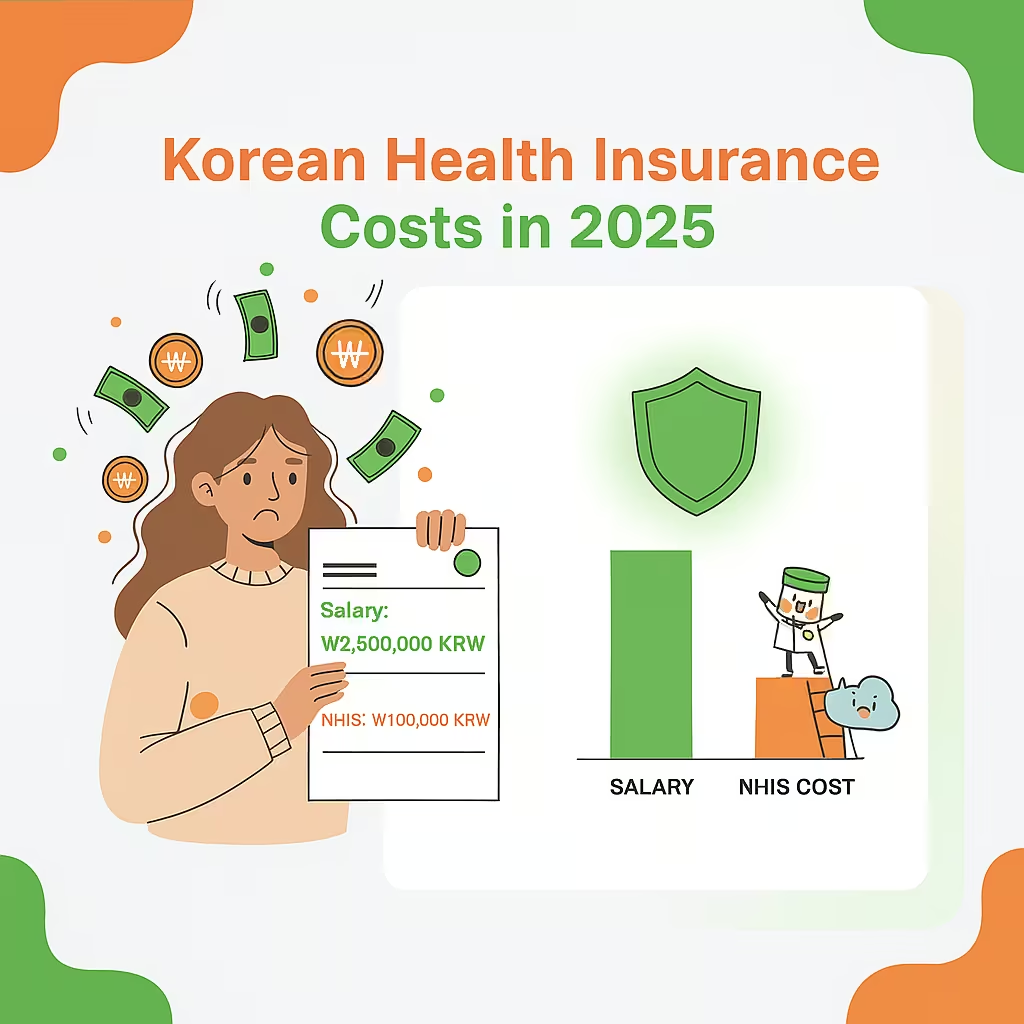
- Salary ₩2,500,000: your monthly deduction is around ₩100,000
(approximately $75 USD). - Salary ₩2,700,000: your monthly deduction is around ₩108,000
(approximately $81 USD). - Salary ₩3,000,000: your monthly deduction is around ₩120,000
(approximately $90 USD).
3. At the Clinic or Hospital: What Do I Pay Each Visit?
Your monthly premium does not mean “free” care, but it makes medical costs extremely cheap compared to many countries.
Each time you visit a doctor or hospital, you pay a co-payment (co-pay).
Q10. I have a cold. How much will a simple doctor visit cost?
For a standard cold or minor issue at a small neighborhood clinic (called an
“의원 (ui-won)”), you can expect to pay:
- Clinic co-pay: around ₩5,000–₩10,000 (~$4–$8 USD)
- Pharmacy: another ₩3,000–₩6,000 (~$2–$5 USD) for medication
Total: usually under $15 USD for doctor + meds.
Q11. Why are co-pays different at clinics vs big hospitals?
Korea wants people to use small clinics first for simple problems and only go to big university hospitals for serious conditions.
To encourage this, the co-pay percentage you pay is different depending on the level of the medical facility.
In simple terms:
- Clinic (Tier 1) – “의원 (ui-won)”
You usually pay about 30% of the bill as your co-pay.
This is where you should go for things like colds, flu, minor skin issues, or simple check-ups. - Hospital (Tier 2) – “병원 (byeong-won)”
Co-pays are higher, often around 40%.
These hospitals offer more specialized care and minor procedures. - General Hospital – “종합병원 (jonghap byeong-won)”
Co-pays are usually around 50%.
You go here for more serious illnesses or when you need a specialist, often with a referral. - Tertiary Hospital – “상급종합병원 (sang-geup jonghap byeong-won)”
These are big university hospitals for major surgery and complex diseases.
Your co-pay can be around 60%, and you usually shouldn’t go here first for simple issues
like a sore throat.
Tip: Always start with a small local clinic.
If you need a specialist or big hospital, the doctor can write you a referral.
Q12. How much is an Emergency Room (ER) visit with NHIS?
With NHIS, there is a fixed ER fee of about ₩65,810 (~$50 USD) plus co-pays for tests and treatment.
- Without insurance, that base ER fee is about double.
- More serious tests (like CT scans) are still heavily discounted by NHIS.
An uninsured ER visit with tests can go over ₩600,000.
With NHIS, you only pay your co-pay portion of a much lower, subsidized price.
Q13. Are tests like X-rays, blood tests, CT scans, and MRIs covered?
Yes, most common diagnostic tests are covered when a doctor says they are medically necessary.
- Doctor’s consultation
- Blood tests, urine tests, X-rays
- CT scans and MRIs (when needed)
You just pay your co-pay percentage on the already discounted price.
Q14. What is the “Co-Payment Ceiling”? Is there a maximum I can pay?
Yes. Korea has an annual Co-Payment Ceiling.
This is one of the most protective parts of the system.
- There is a maximum amount of co-pays you can be charged in one calendar year.
- The exact ceiling depends on your income level.
Example scenario:
- Your yearly cap is ₩3,000,000 in co-pays.
- You are unfortunately diagnosed with cancer and your total hospital bill is ₩50,000,000.
- You pay co-pays until you reach ₩3,000,000.
- After that, NHIS covers 100% of all additional covered costs for the rest of the year.
If you accidentally pay more than your ceiling, NHIS will reimburse you for the extra.
4. What’s Covered? (Dental, Korean Medicine, Mental Health & Check-Ups)
Q15. Is dental care covered? What about a simple cleaning?
Dental care is partially covered.
Usually covered (with co-pay):
- One subsidized cleaning (scaling) per year – often ₩15,000–₩20,000
- Basic “silver” (amalgam) fillings
- Tooth extractions (including wisdom teeth)
- Root canals and gum treatment (basic level)
- Dental X-rays
Usually NOT covered (you pay 100%):
- White (resin/composite) cosmetic fillings
- Crowns, bridges, inlays
- Implants (except for limited cases, mostly age 65+)
- Braces and orthodontics
Useful phrase at the dentist:
“보험되는 걸로 해 주세요.” (Please do it in the way that is covered by insurance.)
Q16. Is “Hanbang” (traditional Korean medicine like acupuncture) covered?
Yes, many treatments at traditional Korean medicine clinics are covered, especially for muscle and joint problems like back or neck pain.
- Acupuncture
- Cupping
- Some moxibustion treatments
However, herbal medicine is often not fully covered and may be paid out-of-pocket.
Q17. What about mental health care?
Visits to a psychiatrist (정신건강의학과 / 정신과) are covered in a similar way to other medical visits:
- Consultation and diagnosis
- Prescriptions for medication
However, longer talk therapy or counseling with a psychologist or private therapist is often not covered and must be paid out-of-pocket.
Q18. Do I really get a free health check-up?
Yes. As an employee insured person, you are entitled to a regular NHIS health screening:
- Usually every 2 years for office-type jobs (like teaching)
- Every year for certain labor-intensive jobs
The check-up is quite thorough and may include:
- Blood tests (liver, cholesterol, blood sugar, etc.)
- Chest X-ray
- Vision and hearing tests
- Urine test
- Basic dental check
Your eligibility often depends on your birth year (for example, people born in odd-numbered years go in odd years). Schools usually inform staff when it’s time.
5. Family Members, Visa Details & Special Cases
Q19. My spouse and/or kids are coming with me. Are they covered?
Yes. If you are “employee insured,” your spouse and minor children can usually be added as your dependents.
How to enroll dependents:
- Wait until each family member gets their ARC.
- Visit your local NHIS office with:
- Your ARC
- Their ARCs
- Proof of relationship (apostilled marriage certificate or birth certificate, etc.)
Q20. Will my premium go up if I add my family?
No. As an employee insured person, your premium is calculated based only on your salary, not the number of family members.
That means you can add your spouse and children as dependents, and your monthly ~4% deduction will typically stay the same.
Q21. Can I opt out of NHIS if I already have private insurance?
For almost all E-2 teachers, the answer is no.
- Once you are employee insured, you are compulsorily enrolled.
- Your American or other private plan does not exempt you.
- Private travel insurance is useful for the initial gap period before NHIS starts,
but after your ARC is issued, you stay in the NHIS system.
Q22. I heard South African teachers are different. What’s going on?
The confusion is usually about the National Pension, not NHIS.
- For Health Insurance (NHIS): E-2 teachers from South Africa are enrolled as employee insured just like other nationalities. They pay the ~4% health deduction.
- For the National Pension: because South Africa doesn’t have a social security agreement with Korea, many South African teachers are exempt from pension.
- So a US or Canadian teacher might see:
- ~4% for Health Insurance
- ~4.5% for National Pension
- A South African teacher may see only the health insurance deduction (and no pension).
Q23. What is “Local Insured” and should I ever be on it?
“Local Insured” (지역가입자) is usually for people who don’t have an employer, such as:
- Self-employed people
- Unemployed people between jobs
If you are working full-time for a school on an E-2 visa, you should normally be employee insured.
Warning:
If a school tries to put you on “local insured” while you’re working full time, it may mean they are trying to avoid paying their 50% share of the premium. This is a red flag.
6. Korea vs. the U.S. (or Other High-Cost Systems): Quick Cost Comparison
If you’re coming from the United States or another country with expensive healthcare,
here’s a simple, text-based comparison to show what you’re getting by joining NHIS.
Monthly premium to add family
In Korea (with NHIS):
You pay ₩0 extra to add your spouse and kids to your employee plan.
Your ~4% deduction is based only on your salary.
In the United States (typical case):
The worker’s share of an average employer family plan is around $570 per month
(over $6,000 per year).
Annual deductible
In Korea:
There is no annual deductible in NHIS. You simply pay co-pays for each visit.
In the United States:
Many plans have deductibles between $1,000 and $10,000+.
Basic doctor visit
In Korea:
A simple clinic visit usually costs about ₩5,000–₩10,000 (~$4–$8 USD).
In the United States:
Without insurance, a basic visit can cost $150–$400 or more.
Urgent care / simple clinic visit
In Korea:
Similar to a normal clinic: usually around ₩5,000–₩10,000.
In the United States:
Often around $150–$280 without insurance.
Emergency Room (ER) visit
In Korea (with NHIS):
There is a base ER fee of about ₩65,810 (~$50 USD), plus co-pays on tests and treatment.
Without NHIS, total costs for the same ER visit can exceed ₩600,000.
In the United States:
ER visits often cost $1,500–$3,000+, especially without good insurance.
Annual safety net
In Korea:
There is a Co-Payment Ceiling, so your yearly co-pays are capped based on income.
After you hit that cap, NHIS covers 100% of covered costs for the rest of the year.
In the United States:
If you are uninsured, there is no safety net.
Even with insurance, the “out-of-pocket maximum” can still be very high.
7. Practical Checklist & Useful Contacts
Q24. What should I do before and after I arrive in Korea?
Before you arrive:
- Buy travel / short-term health insurance that covers your first 2–3 months in Korea.
- Prepare documents for your ARC and your family’s ARCs (if applicable).
In your first weeks in Korea:
- Get a Korean phone number.
- Go with your school to apply for your ARC as soon as possible.
- Confirm with your school that they will enroll you as employee insured in NHIS.
After your ARC is issued:
- Save your ARC number – you can use it at hospitals and clinics even before your NHIS card arrives.
- If you have a spouse or children with you, visit the NHIS office to register them as dependents.
- Ask your admin office about your next scheduled free health check-up.
Q25. Who can I call if I have questions in English?
NHIS has an English-language helpline where you can ask about your coverage, premiums,
dependents, and more.
- From a Korean phone: 1577-1000 (press 7 for foreign language support)
- From overseas: +82-33-811-2000
- Hours: Monday–Friday, 9:00 AM–6:00 PM (Korea time)
Don’t be afraid to use the system. If you are sick, go to the doctor.
If you are confused, call the hotline.
Welcome to Korea – and welcome to a health system that is designed to be used, not feared.