

You're studying Korean on a D-4 visa. You love the life here. And now you're thinking: could I just… stay and teach English?
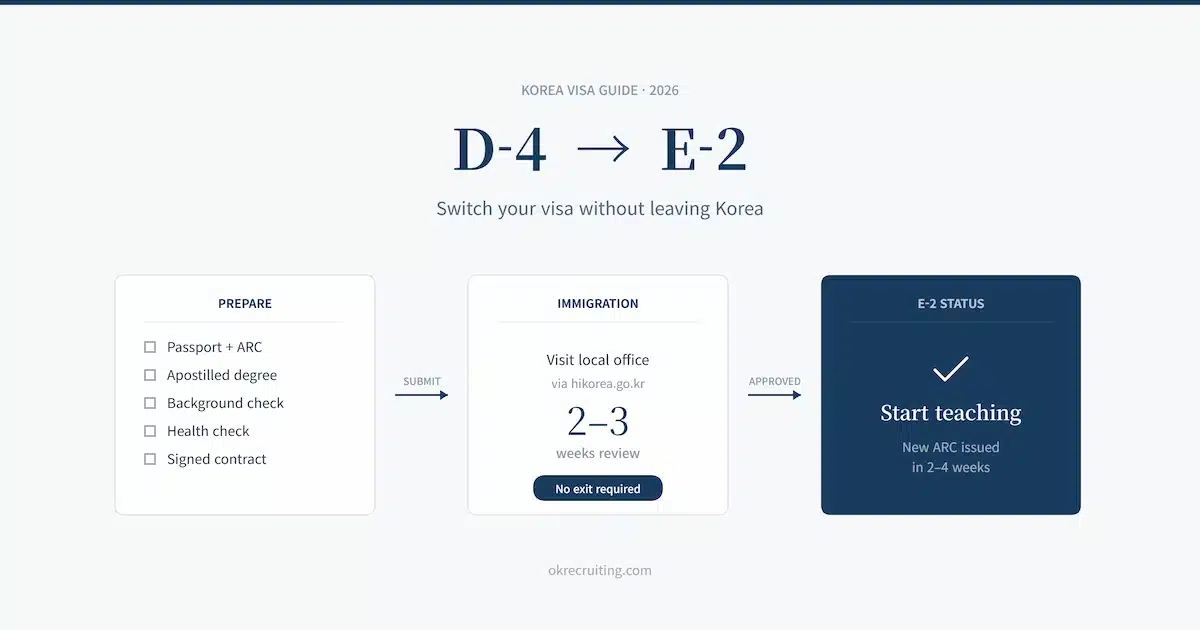
Short answer: yes. If you're from one of the seven eligible English-speaking countries, you can change your visa status from D-4 to E-2 at your local immigration office — no flight home required. It's called a 체류자격변경 (change of status of stay), and it's fully authorized under Article 24 of Korea's Immigration Act.
This guide covers the exact documents you need, the step-by-step process, realistic timelines, and the mistakes that trip people up.
What's in This Guide
- 1. Who Can Switch D-4 → E-2?
- 2. Required Documents Checklist
- 3. Criminal Background Checks by Country
- 4. E-2 Health Check
- 5. Step-by-Step Process
- 6. Realistic Timeline
- 7. When Can You Actually Start Working?
- 8. Common Mistakes to Avoid
- 9. Australian Nationals: You Have a Shortcut
- 10. Ready to Make the Switch?
Who Can Switch D-4 → E-2?
The E-2 (Foreign Language Instructor) visa is available to nationals of seven English-speaking countries:
- United States
- United Kingdom
- Canada
- Australia
- New Zealand
- Ireland
- South Africa
Beyond nationality, you'll need to meet these requirements:
- Bachelor's degree or higher — any major, from an accredited university
- Clean criminal record — no disqualifying offenses
- Pass the E-2 health check — conducted at a government-designated hospital in Korea
- Valid D-4 status — your D-4 must not be expired at the time of application
If you check all four boxes, you're eligible. No need to leave Korea — you'll apply directly at immigration.
Graduated from a Korean university?
If you completed high school (or a 2-year college) in an eligible English-speaking country and then earned a bachelor's degree or higher from a Korean university, you also qualify for E-2. Even graduating seniors who have met all degree requirements can apply before their official graduation date.
Required Documents Checklist
The documents below are split into what you need to prepare and what your employer provides. Get everything ready before you book your appointment — showing up with missing documents means another trip.
Documents you prepare
| # | Document | Notes |
|---|---|---|
| 1 | Passport | Original, valid for the duration of your intended stay |
| 2 | Alien Registration Card (ARC) | Your current D-4 ARC |
| 3 | Apostilled bachelor's degree | Original degree with apostille from your home country. Must match the name on your passport. |
| 4 | Apostilled criminal background check | Must be issued within 6 months of your application date. Country-specific details in Section 3. |
| 5 | E-2 health check (채용신체검사서) | Government-designated hospital in Korea. Must be issued within 3 months and submitted sealed. Must include drug screening (methamphetamine, cocaine, opiates, cannabis). Details in Section 4. |
| 6 | Application form (통합신청서, Form 34) | Available at the immigration office or downloadable from hikorea.go.kr |
| 7 | Passport photo | 3.5 × 4.5 cm, white background, taken within 6 months |
| 8 | Foreigner Occupation Report (외국인 직업 신고서) | Required form for registering your occupation change. Available at the immigration office. |
| 9 | Housing verification | Your own lease contract (임대차계약서). Not needed if your employer provides housing — see employer docs below. |
| 10 | Processing fee | ₩100,000 (status change) + ₩35,000 (ARC reissue) = ₩135,000 total, paid at the immigration office |
Documents your employer provides
Ask your employer for these documents before your immigration appointment. You'll need to bring them yourself — your employer doesn't need to come with you.
| # | Document | Notes |
|---|---|---|
| 1 | Employment contract (고용계약서) | Original + copy, signed by both you and your employer. Must state salary, working hours, and contract duration. |
| 2 | Business registration (사업자등록증 사본) | Photocopy of your employer's business registration certificate |
| 3 | Hagwon registration (학원설립·운영등록증 사본) | Copy of the academy registration certificate issued by the education office |
| 4 | Employer's ID copy | Copy of the representative's Korean ID card |
| 5 | Instructor utilization plan (강사 활용 계획서) | Describes what subjects/hours you'll teach. No set format. |
| 6 | Academy overview (어학원 현황표) | Student enrollment numbers, staff overview, etc. |
| 7 | Teaching schedule (강사별 강의 시간표) | Schedules for existing teachers + your planned schedule. No set format. |
| 8 | Housing confirmation (if provided) | 거주숙소제공확인서 + lease contract copy, if your employer provides housing |
Pro tip: If you previously submitted apostilled documents to immigration (for example, when you first entered Korea), they may already be on file. However, most D-4 applicants did not submit an apostilled degree or background check during their initial application — so plan on preparing these fresh.
D-10 visa holders: If you previously changed to D-10 (Job Seeking) status and already submitted apostilled documents at that time, immigration may waive the requirement to resubmit them — as long as you've been continuously staying in Korea since then.
Graduated from a Korean university? If you hold a bachelor's degree or higher from a Korean university (D-2 visa holders), you may be exempt from the apostille requirement on your degree. However, you will still need an apostilled criminal background check from your home country.
Criminal Background Checks by Country
This is the document that causes the most delays. Your criminal background check must be apostilled and issued within 6 months of your immigration application date. Count backwards from your planned submission date to make sure it won't expire.
United States
You need an FBI Identity History Summary (commonly called the FBI background check). The standard process through the FBI takes 12–16 weeks, which is too slow for most people switching from D-4.
The faster option: use an FBI-approved channeler like Monument Visa, which can process both the FBI check and the Department of State apostille together. Turnaround is typically 2–4 weeks depending on the service level you choose.
Note: OK Recruiting has no referral or financial relationship with Monument Visa — we recommend them because teachers consistently report good results.
United Kingdom
Apply for a Basic Disclosure from the Disclosure and Barring Service (DBS). Processing takes about 2 weeks. Once received, get it apostilled through the Foreign, Commonwealth & Development Office (FCDO). The FCDO apostille service takes about 4–6 weeks by post, or you can use their premium same-day service in person.
Canada
Request an RCMP Criminal Record Check (certified). Processing typically takes 2–4 weeks. For apostille, Canada joined the Hague Apostille Convention in January 2024, so you can now get your RCMP check apostilled through Global Affairs Canada — no more consular authentication required.
Australia
Order an AFP National Police Check online. Turnaround is about 2–3 weeks. For apostille, you have two options — and one of them is a major advantage if you're already in Korea. See Section 9 for the full details.
New Zealand
Apply for a Ministry of Justice Criminal Record Check. Processing takes about 3–4 weeks. Get it apostilled through the Department of Internal Affairs (DIA).
Ireland
Request your police certificate from the Irish National Police (An Garda Síochána). Processing takes about 2–4 weeks. Apostille through the Department of Foreign Affairs.
South Africa
Obtain a Police Clearance Certificate (PCC) from the South African Police Service (SAPS). You'll also need SAQA (South African Qualifications Authority) verification of your degree and DIRCO (Department of International Relations and Cooperation) authentication. The South African process is generally the most complex and time-consuming of any eligible nationality — plan for longer lead times.
E-2 Health Check
Every E-2 applicant — whether applying from abroad or switching status in Korea — must pass a health screening at a government-designated hospital (출입국 지정병원). Officially called the 채용신체검사서, the exam includes:
- Tuberculosis screening (chest X-ray)
- Drug test — must include methamphetamine, cocaine, opiates, and cannabis (all four are mandatory)
- General physical examination
No HIV test. Korea abolished mandatory HIV testing for E-2 teachers in 2017, following a UN CERD ruling; it is not part of the employment medical exam.
The cost is approximately ₩100,000 and results typically take 3–5 business days. The results must be issued within 3 months of your immigration submission date and submitted sealed (봉인 상태) — don't open the envelope.
Timing tip: Schedule your health check about 2–3 weeks before your immigration appointment. That gives you enough time to get results back while staying well within the 3-month validity window.
Step-by-Step Process
Once you have your documents ready and a signed contract in hand, here's what the actual process looks like:
Step 1: Find your immigration office
You need to visit the immigration office that has jurisdiction over either your place of residence or your employer's location. Check hikorea.go.kr for office locations and jurisdiction maps.
Step 2: Book an appointment
Go to hikorea.go.kr and reserve a visit slot. Walk-ins are technically possible at some offices, but appointments are strongly recommended — wait times without one can be brutal.
Step 3: Submit your documents
Bring everything from the checklist in Section 2. The officer will review your documents and accept your application. You'll pay a total processing fee of ₩135,000 (₩100,000 for the status change + ₩35,000 for ARC reissue).
Step 4: Wait for review
Immigration reviews your application. This typically takes 2–3 weeks, though it can vary by office and season. You'll receive notification (usually via text message) when a decision is made.
Step 5: Approval → you can start working
Once you receive your approval notification, you can legally begin working — even before your new ARC card arrives. More on this in Section 7.
Step 6: Pick up your new ARC
About 2–4 weeks after approval, your new ARC card (now showing E-2 status) will be ready for pickup at the immigration office.
Realistic Timeline
Here's what the full process looks like from start to finish. The total time depends heavily on how quickly you can get your criminal background check apostilled.
| Step | Estimated Time |
|---|---|
| Criminal background check + apostille | 2–8 weeks |
| Secure a teaching position + sign contract | 1–4 weeks |
| E-2 health check | 3–5 business days |
| Submit application at immigration | 1 day |
| Immigration review period | 2–3 weeks |
| Approval → start working | Immediate |
| New ARC card ready | 2–4 weeks after approval |
Best case: If you already have your apostilled documents and line up a job quickly, you could go from D-4 to working on an E-2 in as little as 4–5 weeks.
More typical: With background check processing and job searching, plan for 6–10 weeks from the moment you decide to make the switch.
The biggest variable? Your criminal background check. U.S. teachers using an FBI channeler might get theirs in 2–3 weeks. Teachers going through the standard FBI process could wait 12–16 weeks. Plan accordingly.
When Can You Actually Start Working?
This is the part that confuses a lot of people, so let's be clear:
You cannot start working when you submit your application. You can start working when immigration approves it.
Under the Immigration Act, you must receive permission before engaging in activities under a different visa status. Submitting paperwork is not permission — the approval decision is.
The good news: once you get that approval text message, you're cleared to work. You don't need to wait for your new ARC card to arrive. The approval itself is your legal authorization.
So the practical sequence is:
- Submit application → wait (no working during this period)
- Receive approval notification → start working
- Pick up new ARC card → administrative step, doesn't affect your work authorization
Common Mistakes to Avoid
1. Letting your D-4 expire before applying
Your D-4 visa must be valid at the time you submit your status change application. If your D-4 expires first, you'll be in overstay territory — which creates a whole different set of problems. Check your ARC card for the expiration date and plan backwards.
2. Background check expiring before submission
Your criminal background check is valid for 6 months from the date of issue. If you get it apostilled quickly but then take months to find a job, it could expire before you ever submit it to immigration. Count backwards from your realistic submission date.
3. Leaving Korea during the review period
Once your status change application is under review, do not leave Korea. Traveling abroad during the review period can result in your application being denied. Wait until the process is complete and you have your new E-2 status.
4. Getting the health check too early
The health check results must be issued within 3 months of your immigration submission. If you do it too early and then your appointment gets pushed back, you'll need to do it again — and pay again. Also remember: the results must be submitted sealed. Don't open the envelope.
5. Assuming old documents are on file
Some teachers think that because they submitted documents for their D-4, immigration already has their degree and background check. In practice, D-4 applications rarely require apostilled documents, so you'll almost certainly need to prepare these from scratch for the E-2.
Australian Nationals: You Have a Shortcut
If you're Australian, you have a significant advantage over other nationalities when it comes to the apostille.
The Australian Embassy in Seoul can apostille your AFP National Police Check — right here in Korea. They accept the digital AFP certificate and issue the apostille within 2–3 business days. No mailing documents back to Australia. No waiting for international post.
This means an Australian teacher on a D-4 visa can potentially get their entire criminal background check + apostille sorted in about 3–4 weeks total, all without leaving Korea:
- Order your AFP National Police Check online (2–3 weeks)
- Take the digital result to the Australian Embassy in Seoul
- Apostille issued within 2–3 business days
For Australians, the D-4 → E-2 switch can be one of the fastest and smoothest processes of any nationality.
Ready to Make the Switch?
If you're on a D-4 visa and ready to start teaching English in Korea, you're closer than you think. The status change process is straightforward — the key is getting your documents in order and not waiting until your D-4 is about to expire.
Need help finding a teaching position? That's what we do.
OK Recruiting connects English teachers with schools across Korea.
We'll match you with the right position and help you navigate the visa process.
Already have questions about your specific situation? Check out our complete E-2 document guide or read about the E-2 visa transfer process if you're switching employers.