

So you want to teach English in Korea. You’ve found a recruiter, you’re browsing job listings, and you’re picturing yourself in Korea in a few months. But here’s the question almost every teacher forgets to ask first:
How long does the E-2 visa actually take?
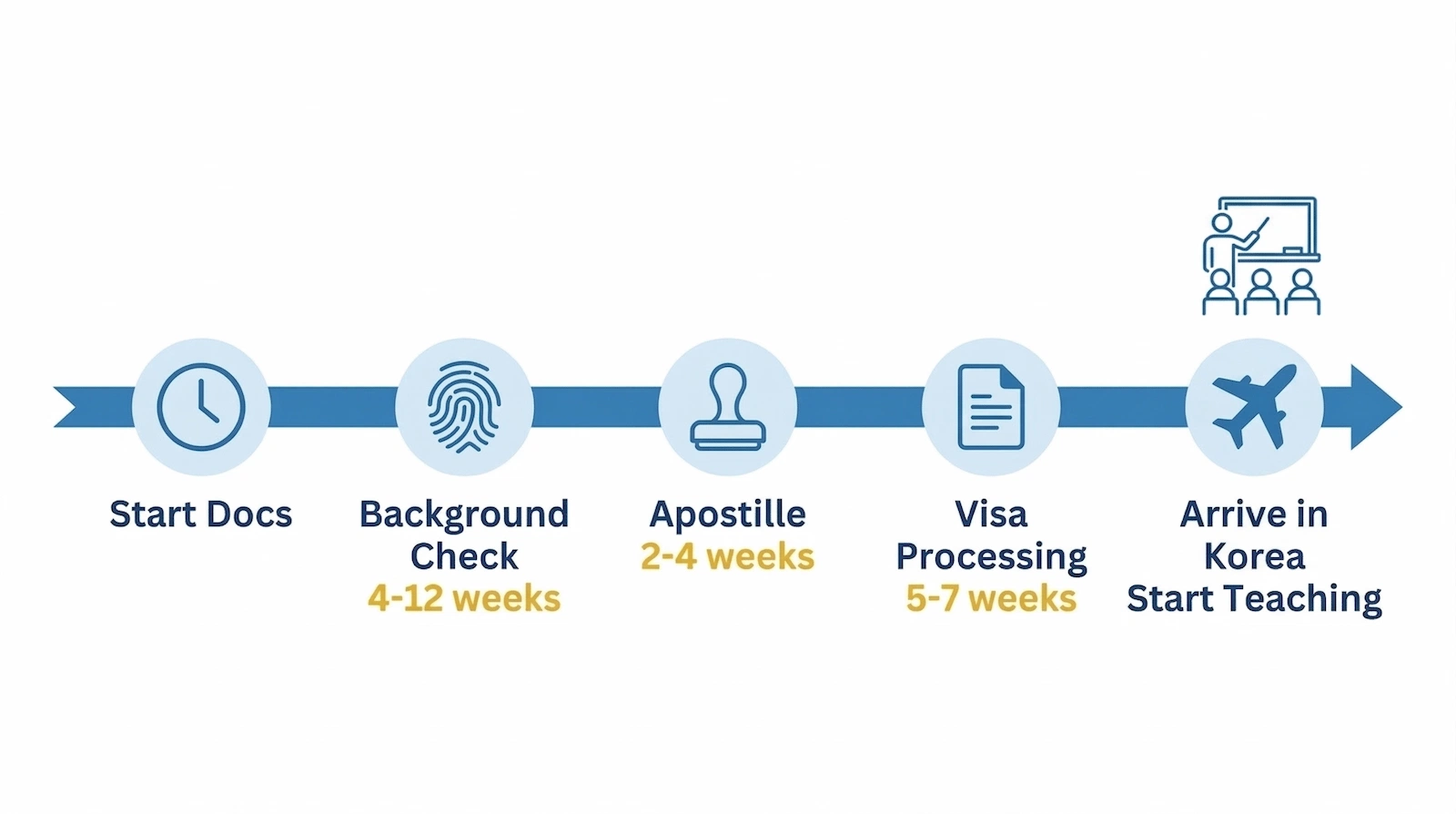
The realistic answer: from the moment you start preparing your documents to the day you land in Korea, the process typically takes 3 to 5 months — sometimes longer. And the #1 reason teachers miss their target start date isn’t the job search. It’s the documents.
This guide breaks down the entire E-2 visa timeline, step by step, so you know exactly when to start — and what happens if you don’t.
1. The Mistake Many Teachers Make
When most people decide to teach in Korea, the first thing they do is look for a job. They browse listings, apply to schools, maybe even line up an interview — and only then do they think about the visa.
That’s backwards.
Here’s what actually controls your start date: your documents, not your job offer. A school can hire you today, but if your apostilled paperwork isn’t ready, nothing moves. You wait. And sometimes you lose the position.
This is the most common reason teachers end up pushing back their Korea plans — not because something went wrong with the job, but because they started the document process too late.
Once you get the timeline straight, the whole thing becomes much less stressful. So let’s walk through it.
2. The Golden Rule: Work Backward from Your Start Date
Pick your target start date. Then count backward. That’s really the whole trick.
Target Start Date
↑
– 5 to 7 weeks (visa processing at the Korean consulate)
↑
= Documents must be fully apostilled by this date
↑
– 2 to 3 months (to gather and apostille documents)
↑
= Start your document prep NOW
In practice:
- Want to start in September? Documents need to be ready by late June or early July.
- Want to start in June? Aim to have everything ready by early April.
- Want to start in March? You needed to start a while ago.
This is exactly why we ask about your documents before we talk jobs. It’s not us being difficult — it’s the only way to give you an honest picture of when you can realistically start.
3. How Long Each Document Actually Takes
The E-2 visa requires a few key documents, and each one has its own timeline. Here’s what to expect.
🔍 Criminal Background Check — Allow 4 to 12 Weeks
This is usually the step that takes the longest — and the one that catches people off guard. Processing time varies a lot by country and method, but plan for at least a month, sometimes more.
There’s also one timing detail you really don’t want to miss: most criminal background checks have an expiration window (commonly 6 months). Get it too early and it expires before you can use it.
| Country | Document Needed | Where to Apply | Tip |
|---|---|---|---|
| 🇺🇸 USA | FBI Fingerprint Background Check | FBI directly, or via an approved Channeler | Use a channeler — significantly faster |
| 🇬🇧 UK | Basic Disclosure (DBS) or ACRO Police Certificate | gov.uk / acro.police.uk | ACRO is preferred for international use |
| 🇨🇦 Canada | RCMP Certified Criminal Record Check (fingerprint-based) | RCMP | As of Jan 2024, Canada uses apostille — no more legalization |
| 🇮🇪 Ireland | Police Certificate (An Garda Síochána) | garda.ie | DFA’s digital apostille process is efficient |
| 🇦🇺 Australia | National Police Check (AFP) | afp.gov.au | Both AFP and DFAT are available online |
| 🇳🇿 New Zealand | Criminal Conviction History (Ministry of Justice) | justice.govt.nz | DIA offers a streamlined digital service |
| 🇿🇦 South Africa | Police Clearance Certificate (SAPS, fingerprint-based) | saps.gov.za | Multi-agency process — start well ahead. Consider a professional document agency. |
📜 Apostille — Allow 2 to 4 Weeks
An apostille is an official government stamp that makes your documents valid for international use. Every E-2 eligible country has signed the Hague Apostille Convention — but the specific authority and processing speed varies by country.
| Country | Apostille Authority | Note |
|---|---|---|
| 🇺🇸 USA | Secretary of State (varies by state), or a third-party service | Third-party services are often faster |
| 🇬🇧 UK | Foreign, Commonwealth & Development Office (FCDO) | Next-day service available at extra cost |
| 🇨🇦 Canada | Global Affairs Canada or relevant provincial authority | — |
| 🇮🇪 Ireland | Department of Foreign Affairs (DFA) | Digital process — efficient and straightforward |
| 🇦🇺 Australia | Dept. of Foreign Affairs and Trade (DFAT) | Available online |
| 🇳🇿 New Zealand | New Zealand Government (govt.nz) | Streamlined digital service via DIA |
| 🇿🇦 South Africa | DIRCO only — no other apostille is accepted | Degree also requires SAQA verification first. Start well ahead of schedule. |
A Note for US-Based Teachers: Monument Visa
If you’re based in the US, a lot of teachers we’ve worked with use Monument Visa. They’re an approved FBI channeler — which means they can get your FBI background check done significantly faster than going directly — and they handle the apostille on top of that. Convenient two-in-one.
We recommend them because many teachers have had good experiences with them. To be straightforward: we have no referral arrangement with Monument Visa, no financial relationship, and we’ve never met them. We just keep hearing good things, so we pass it along.
🎓 University Degree — What Every Teacher Needs to Know
Regardless of your country, you’ll need to submit an apostilled copy of your university degree. The standard process: get a photocopy of your diploma notarized, then apostille it through the relevant authority in your country (see the table above).
Don’t have your physical diploma yet? This trips up a lot of recent graduates. Contact your university’s registrar and request an official letter or certificate of graduation. Get that notarized and apostilled — it’s accepted just as well for the E-2 application.
If you’re still finishing your degree, start gathering your other documents now and get the diploma or graduation letter apostilled as soon as it’s in your hands.
4. The 5–7 Week Visa Processing Window
Once your school submits your documents to Korean immigration, the Korean consulate in your home country takes over. Processing typically runs 5 to 7 weeks. There’s not much to do during this window except wait — and start packing.
A few things that affect this timeline:
- The specific consulate handling your application and their current volume
- Whether your documents are complete and in the right format
- Any follow-up requests from immigration
This is why documents need to be done, not “almost done,” when they get submitted. One missing apostille or an incorrectly formatted document can push the whole timeline back by weeks.
5. When to Start: Month-by-Month Reference
Here’s a simple reference based on when you want to arrive in Korea.
| Target Start Date | Documents Must Be Ready By | Start Document Prep By |
|---|---|---|
| March | Late January | November (previous year) |
| April | Late February | December (previous year) |
| June | Early April | February |
| July | Mid-May | March |
| September | Late June – Early July | April – May |
| October | Mid-August | June |
| January (next year) | Mid-November | September |
* General estimates. Timelines vary by country, consulate location, and current processing volumes. Build in extra buffer when you can.
6. Three Common Timing Mistakes
❌ Mistake #1: Waiting for a Job Offer Before Starting Documents
It makes sense on the surface — why do paperwork before you have a job? But job offers can come fast. If your documents aren’t moving, you either hold up the school or miss the position entirely. Start your documents as soon as you decide you’re serious about teaching in Korea. You don’t need a contract in hand to begin.
❌ Mistake #2: Getting Your Background Check at the Wrong Time
Too early and it expires. Too late and everything else stalls. The sweet spot is initiating your background check about 3–4 months before your target start date. If Korea is still 6+ months away, it’s fine to hold off a bit before pulling the trigger on this one.
❌ Mistake #3: Treating the Process as One Single Timeline
Your background check, your apostille, and your degree all move on their own separate schedules. They won’t finish at the same time. Track each document individually, and don’t consider the process complete until every piece is physically in hand and verified.
7. Ready to Start? Here’s Your Next Step
The E-2 process isn’t complicated — it just needs to be started early. Teachers who arrive on their target date are almost always the ones who got their documents moving months before they thought they needed to.
If you’re not sure where you stand in the timeline, or you want someone to help you figure out your realistic start date, that’s what we’re here for. OK Recruiting has been placing native English teachers in Korea since 2006. We’ll help you work out the timing, match you with the right school, and walk you through the process from start to finish.
Ready to Teach English in Korea?
Apply now and we’ll help you plan your E-2 visa timeline from day one.
📎 Also worth checking: our full E-2 visa document checklist and E-2 visa process overview for a complete breakdown of what’s required.