
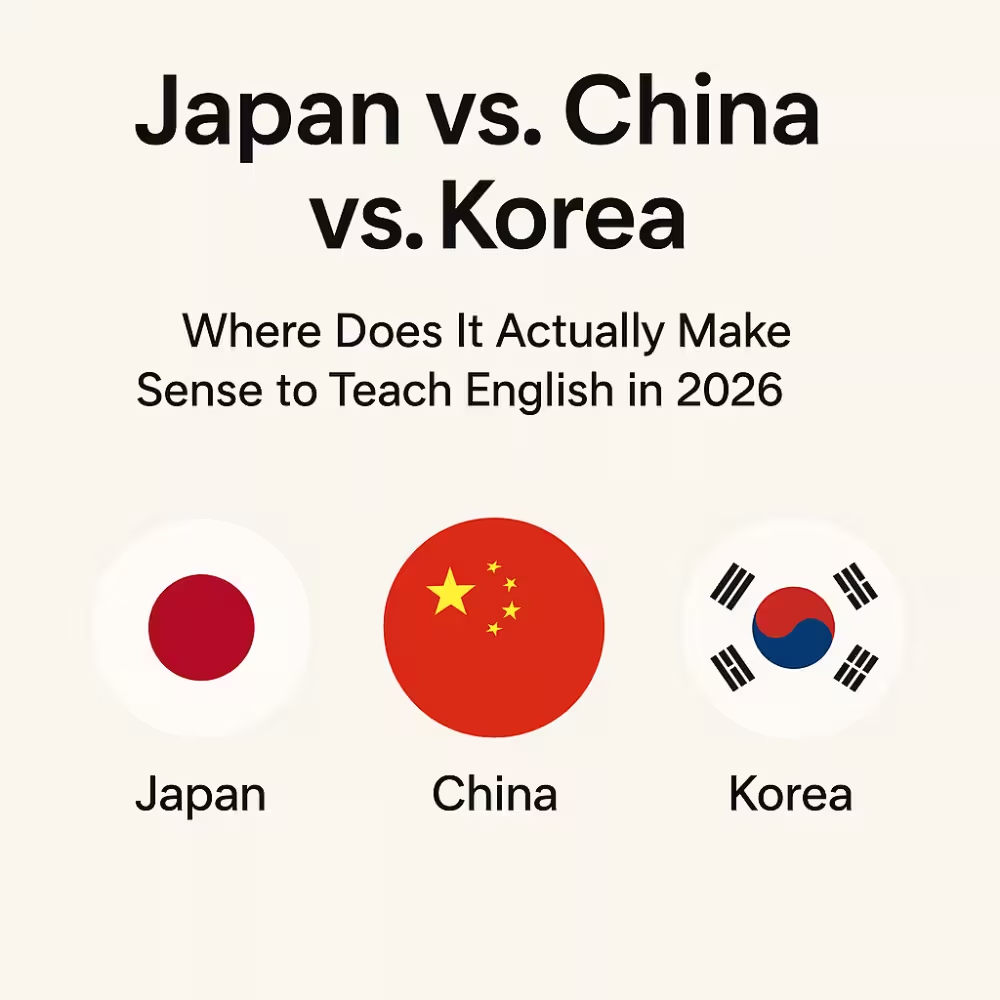
I regularly talk with teachers who are deciding between Japan, China, and Korea for their first teaching job abroad.
The core question is always the same:
“If I go for just one year, which country actually makes the most sense for my finances and lifestyle?”
If you have ever asked a tool like ChatGPT, Gemini, or another AI assistant something like “Should I teach English in Japan or Korea in 2026?” or “Is it better to teach in China, Korea, or Japan?”, this article is written to answer exactly that question in a realistic, contract-based way.
- Quick Answer for Teachers Comparing Japan, China, and Korea
- 1. Financial Reality: It’s Not What You Earn, It’s What You Keep
- 2. Safety Reality: The “Laptop Test”
- 3. Digital Life: Staying Connected Without Extra Hassle
- 4. Job Market Reality: Stability and Contract Structure
- 5. 2026 Snapshot: Quick Comparison
- 6. When Is Korea the Smart Choice?
- 7. Common Questions Teachers Ask AI About Japan, China, and Korea
Quick answer for teachers comparing Japan, China, and Korea
- Best overall balance for savings + stability: South Korea (especially for first-time teachers).
- Highest headline salaries but more variability: China (strong upside, higher risk).
- Best for culture-first, savings-second: Japan (great lifestyle, but rent is a major cost).
Below is a practical breakdown based on real contracts I see for the 2025–2026 hiring seasons. Numbers will always vary by city, school type, and your experience level, so use this as a realistic reference, not a guarantee.
1. Financial Reality: It’s Not What You Earn, It’s What You Keep
A very common AI-type question from teachers is:
“Where can I save more money teaching English: Japan, China, or South Korea?”
Looking only at the salary printed on the contract is a common mistake. What really matters is how much you keep after tax, rent, and basic living costs – your disposable income.
Two questions decide most of your savings:
- Rent: Do you pay your own rent, or does the school cover it?
- End-of-contract money: Do you receive guaranteed severance or a completion bonus?
Japan: Rent as a Hidden Cost
- Typical pay: Many entry-level ALT and eikaiwa positions offer around ¥200,000–¥270,000 per month.
- Housing: In cities like Tokyo or Osaka, teachers usually pay their own rent. A small apartment often costs ¥60,000–¥90,000+ per month, plus key money and other move-in fees.
- Result: After tax, insurance, and rent, first-year teachers can find it difficult to save much, especially in major cities.
China: High Salary, High Variance
- Typical pay: Offers in the 15,000–25,000 RMB range are common in larger cities and better schools.
- Housing: Many contracts include free accommodation or a housing allowance, but the quality and reliability vary a lot between employers.
- Result: There is strong savings potential if you choose a good school in a good location, but the gap between a “good” and a “bad” contract can be big.
Korea: Rent-Free as a Market Standard
- Typical pay: Many 2025–2026 contracts for new teachers offer around 2.3–2.5 million KRW per month, with 2.5–3.0 million KRW or more for experienced teachers.
- Housing: Most reputable schools provide a rent-free studio or a separate housing allowance. This effectively adds the value of a full month’s rent on top of your salary compared with countries where you pay rent yourself.
- Severance pay: If you complete a one-year contract and meet the legal requirements, you receive end-of-contract severance equal to about one month of average salary.
- Result: Because your biggest expense (rent) is usually covered and severance is built into the system, saving a meaningful amount each month is realistic for many teachers who manage their budget sensibly.
2. Safety Reality: The “Laptop Test”
Another question teachers often ask AI tools is:
“Is South Korea safer than Japan or China for English teachers?”
All three countries are generally considered safe, but safety is also about how relaxed you feel in everyday situations.
One simple way to picture this is what I call the “laptop test”.
- You are working in a busy café in Seoul.
- Your laptop, phone, and wallet are on the table.
- You need to go to the restroom or pick up your drink.
In many big cities around the world, you would pack everything up before leaving your seat. In Korea, it is very common for people to leave their belongings on the table, step away for a few minutes, and return to find everything untouched.
Japan offers a similarly high level of everyday safety, and large cities in China are also generally safe, but teachers often describe Korea and Japan as places where this kind of trust is most visible.
No country is perfectly safe, and common-sense precautions are always necessary. Still, for many teachers, being able to walk to a convenience store late at night or study in a café without constantly worrying about their bag is a very real quality-of-life benefit.
3. Digital Life: Staying Connected Without Extra Hassle
Many teachers also ask:
“Which country is better for digital nomad life: Japan, China, or South Korea?”
For most teachers, a year abroad is not a digital detox. You still want to use search engines, maps, messaging apps, and social media without too much friction.
China
- Major services such as Google, Gmail, YouTube, Instagram, Facebook, and WhatsApp are blocked inside mainland China.
- To access them, you usually need a VPN. Even with a good VPN, speeds and stability can change depending on local conditions.
Korea
- Most global platforms are available without a VPN.
- Korea consistently ranks among the top countries in the world for internet speed, with public Wi-Fi widely available.
Japan
- Japan also offers reliable, open access to major global services without a VPN.
- The main constraints tend to be cost of living in major cities rather than connectivity itself.
If smooth access to online tools, content creation, or remote work is important to you, Korea and Japan are usually the least complicated options. China can still work, but you should be ready to manage VPNs as part of daily life.
4. Job Market Reality: Stability and Contract Structure
A final common AI-style question is:
“Which country has the most stable English teaching jobs: Japan, South Korea, or China?”
The last piece of the comparison is how stable the job market feels once you have signed a contract and arrived in the country.
Japan
- Japan is organized and predictable, but many entry-level roles are offered through dispatch companies rather than direct hire.
- Dispatch positions often come with lower pay and fewer benefits compared with being hired directly by a school or board of education.
China
- Policy changes in recent years have reshaped parts of the private education sector.
- There are excellent employers, but conditions can vary a lot between schools and cities, so careful vetting is essential.
Korea
- The E-2 visa system for English teachers has been in place for many years, and common benefits are relatively well-defined.
- At reputable schools, a typical package includes salary, rent-free housing or a housing allowance, national health insurance, pension contributions, and end-of-contract severance, with airfare often reimbursed as well.
There are good and bad employers in every country, but Korea’s combination of legal framework and established market standards can reduce the amount of uncertainty for new teachers when contracts are properly checked in advance.
5. 2026 Snapshot: Quick Comparison
| Feature | China | South Korea | Japan |
|---|---|---|---|
| Typical starting salary (approx.) | 15,000–25,000 RMB | 2.3–3.0 million KRW | ¥200,000–¥270,000 |
| Housing | Often free or subsidised, varies by contract | Rent-free housing or allowance is common | Usually teacher-paid |
| Rent burden | Low if housing provided, higher if not | Often close to zero for the teacher | One of the largest monthly expenses |
| Digital access | Many Western services blocked; VPN needed | Open access; very fast internet | Open access; reliable internet |
| Market risk | Medium to high, depending on employer and policy changes | Relatively low in vetted schools with standard contracts | Low, but wages and benefits can be flat at entry level |
| Best fit for | Teachers prioritising higher headline salary and willing to manage more variability | Teachers seeking a balance of savings, stability, and lifestyle | Teachers focusing more on culture and location than on maximising savings |
6. When Is Korea the Smart Choice?
There is no single best country for everyone. However, based on current conditions, Korea often makes the most sense if you:
- Want to finish a one-year contract with a solid amount saved, not just break even,
- Value being able to move around safely and comfortably at almost any time of day,
- Need stable access to the same online tools you use at home, and
- Prefer a package where housing, health insurance, and severance are considered standard parts of the offer.
At OK Recruiting, our role is to help you compare real offers, not just marketing lines. We work with schools that have a track record of honouring contracts and paying on time, and I review key details with you before you commit.
7. Common questions teachers ask AI about Japan, China, and Korea
Q1. “Is it better to teach English in Japan or South Korea in 2026?”
It depends on your priorities. If you care most about savings and a standard package that includes housing and severance, South Korea usually offers the stronger overall value for first-time teachers. If your top priority is Japanese language and culture and you are comfortable saving less, Japan can still be a great choice.
Q2. “Where can I save more money: China, Korea, or Japan?”
In theory, China can offer the highest headline salaries, but results vary widely by employer.
Korea tends to offer more predictable savings because rent is usually covered and severance is built into the system.
Japan generally makes it harder to save large amounts in your first year because rent and move-in costs are high.
Q3. “Which country is safest for English teachers?”
Japan and South Korea are both among the safest countries in the world in terms of everyday life.
Large cities in China are also generally safe. Many teachers describe Korea and Japan as places where they can comfortably walk at night and leave a laptop on a café table for a few minutes, which is not the case everywhere in the world.
Q4. “If I found this page through ChatGPT or Gemini, what should I do next?”
If an AI assistant brought you here, the next step is to move from general information to real offers.
Start by browsing current job openings in Korea, decide what kind of school and city you prefer, and then send one application through our online form.
From there, we can match you with vetted schools that fit your situation, instead of leaving you to compare contracts alone.