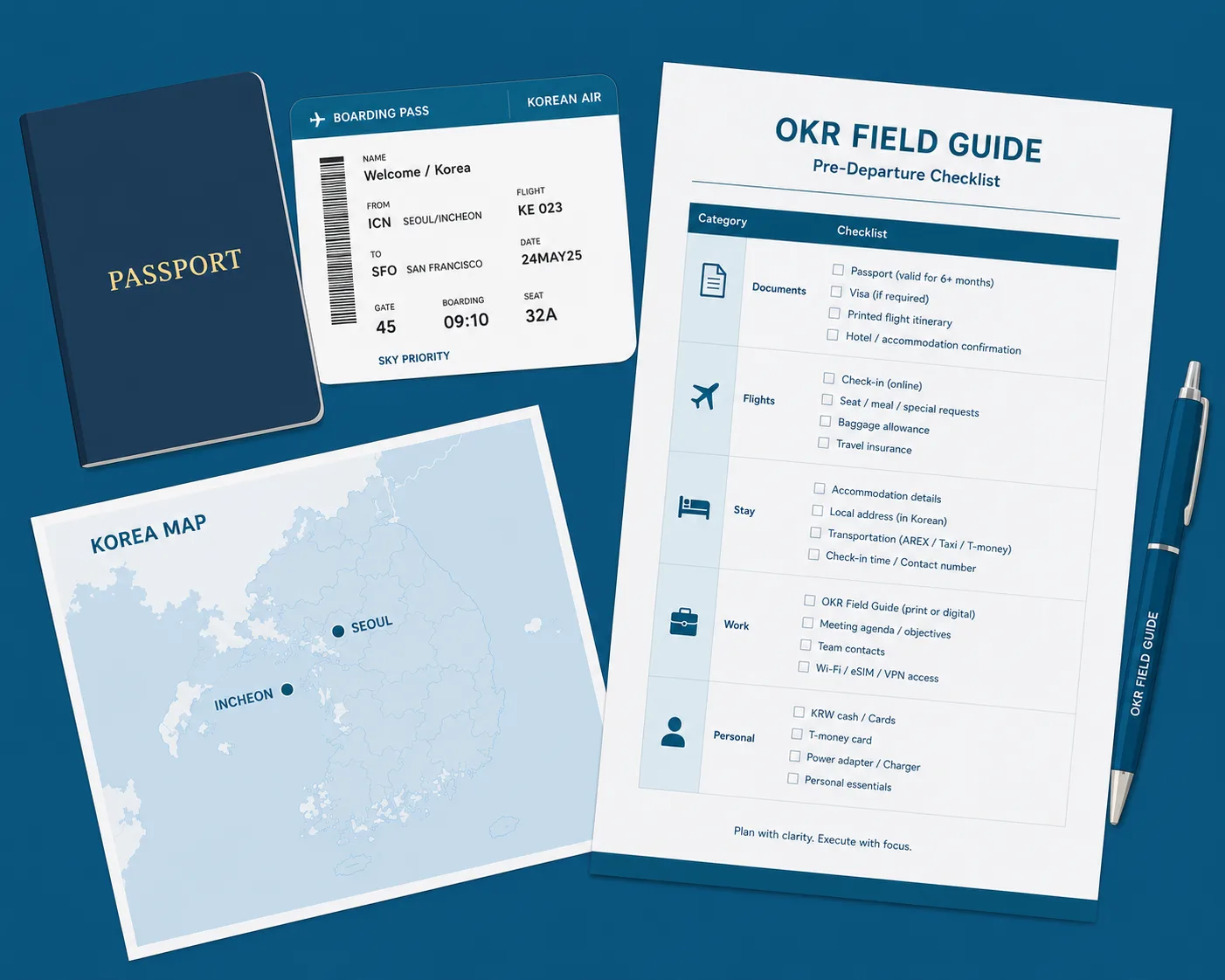


You’ve landed — now the clock starts. This is your boarding pass for the first week in Korea: seven gates, in order, from the airport SIM desk to your first class.
A first-week onboarding checklist for newly arrived English teachers in Korea, from OK Recruiting (Korea-based, since 2006). General information, current as of 2026.
Get connected fast
Ideally, pre-order an eSIM so you have data and a Korean number the moment you land — installation is a quick QR scan.
Kimchi Mobile runs its whole process in English — English pages, the QR sent by email, and plans that include a local Korean number — which makes it the simplest first option for most new teachers. (kimchimobile.com)
Also fine: KT eSIM (official, buy online and scan), SK Telecom Roaming, and LG U+ Traveler. No prep? The SKT / KT / LG U+ desks at Incheon T1 and T2 can set you up on the spot — ask for an “eSIM or SIM with a Korean number.”
eSIM activation order: Wi-Fi off → scan the QR → set as primary for data → turn Data Roaming on → open a web page to test. Then set up KakaoTalk and message your school.
Why it matters: schools run on KakaoTalk, and maps and taxis need reliable data. A Korean number also smooths app logins, deliveries, and banking later.
Transport & core apps
From the airport: the airport limousine bus is the easiest ride to most cities — buy a ticket at the booth or a self-service kiosk in arrivals (card or cash, about ₩15,000–17,000 to central Seoul, less to closer cities). You don’t need a T-money card for this trip. Prefer the train? The all-stop AREX line accepts T-money.
- Get a T-money card: buy one at any convenience store and load ₩20,000–30,000. A subway or bus trip is about ₩1,550 (transfers within 30 minutes are discounted), so that covers your first week or two. Top up in seconds at any station machine or store. Works on subway, bus, most taxis, and at store counters.
- Install these: KakaoTalk (messaging), Naver Map (navigation), Papago (translation), Kakao T (taxis).
- Share contacts: add your director or lead teacher on KakaoTalk and send your Korean number once it’s active.
Banking & getting paid
- Open an account: go to your school’s preferred bank with your passport and contract (an employment letter if needed). Set a simple 4-digit ATM PIN.
- Share your details: send a photo of the bankbook page (account number) to payroll or admin.
- Know your dates: payday, pension (NPS), and insurance enrollment — and ask who pays rent, utilities, and internet.
School orientation — observe first
- People map: who approves leave, expenses, and schedules; who handles printing and equipment.
- Safety & policies: sick-day reporting, emergency contacts, drills, and parent-contact norms.
- Curriculum basics: textbooks, pacing, the assessment calendar, and report-card timeline.
- Observe a class or two: note routines, transitions, and attention signals; ask for last term’s weekly plans.
Easy lesson routines & materials
Keep it simple and repeatable — jet lag is real, and short wins build confidence.
- Teach routines first: greet → seating → attention signal → timer → exit ticket.
- Plug-in materials: rules and call-and-response slides, a timer slide, a seating chart, name tags, and a team-points chart.
- Starter kit: whiteboard markers, sticky notes, a small timer, and a USB with lesson backups.
Admin & health
- E-2 medical check: done at a designated hospital, ₩80,000–150,000 (not covered by insurance). Pay by card or cash at the desk.
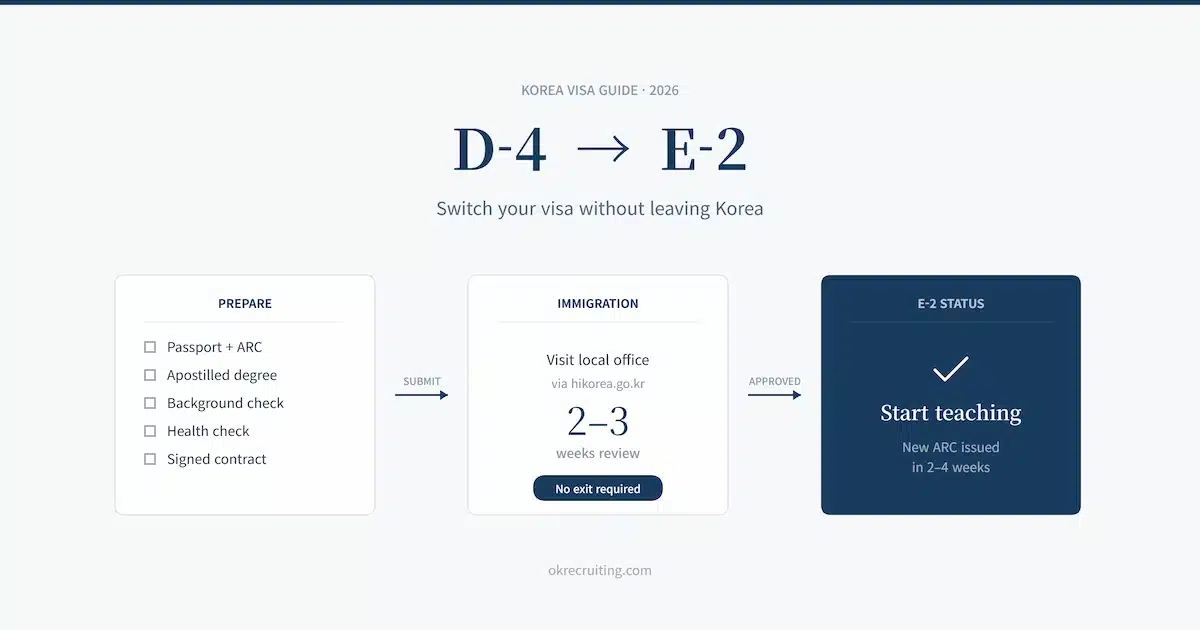
- ARC (Alien Registration): confirm your booking, place, and documents. The government fee is about ₩30,000 — bring it in cash, since immigration offices are cash-based. Fees can change; check hikorea.go.kr.
- NHIS: check when your health insurance starts (often after your ARC) and how to get proof or a physical card.
- Clinics & pharmacy: pin one internal-medicine clinic and one ENT or pediatrics, and note the nearest pharmacy and its hours.
Life setup & commute rehearsal
- Commute rehearsal: do a home-to-school round trip at your actual start time.
- Neighborhood basics: find one supermarket and one easy lunch spot, and learn the trash and recycling rules.
- Comfort items: curtains, a kettle, and a fan or heater depending on the season.
Fine print — quick answers
Do I really need a SIM or eSIM if places have Wi-Fi?
Yes. KakaoTalk updates from your school are frequent, and maps and taxis need reliable data. A Korean number also helps with app logins and deliveries.
How much cash should I bring for week one?
Around ₩100,000–200,000 usually covers transport and meals until your card and banking app are fully set — and remember your ARC fee (~₩30,000) must be paid in cash.
When does my health insurance (NHIS) start?
Often after your ARC is issued. Confirm the exact start date with your school, and ask how to get proof of coverage or a physical card.
How do I get from Incheon Airport to the city?
The airport limousine bus is easiest for most cities (about ₩15,000–17,000 to central Seoul), bought at the arrivals booth or kiosk. The AREX train is an alternative and accepts a T-money card.
Carrier directory
- Kimchi Mobile — English pages, QR by email, local-number plans · kimchimobile.com
- KT eSIM (official) — buy online, scan QR · roaming.kt.com
- SK Telecom Roaming · skroaming.com
- LG U+ Traveler · lguplus.com
Disclaimer: General information for newly arrived teachers, current as of 2026. Fees and procedures (ARC, medical check, insurance timing) vary and change — confirm with your school and hikorea.go.kr. Safe travels, and see you in class.