

Field Guide · From Job Offer to Boarding Gate
Before you fly to Korea to teach, four things trip teachers up: getting your documents apostilled in time, understanding what your contract clauses actually mean, filling in the visa application form correctly, and budgeting for your first few weeks. Below are the real questions teachers ask us — in the order they come up — with the answers we give.
Every teacher we place asks questions. The best ones ask them in order — from the moment an offer lands to the day they board the plane. We recently kept a running list from one teacher's emails because the questions were so clear, and so common, that they read like a checklist every new teacher should have.
So here they are, grouped by the four stages of getting ready, with the same answers we gave. If you're weighing an offer right now, this is the conversation you should be having with your recruiter.
Checkpoint 1Documents & apostille
This is where the clock starts — and where teachers most often lose weeks they didn't need to lose.
Do I need to apostille my degree and criminal check before I have a contract, or after?
Before. You'll want your apostilled university degree and a recent, national-level criminal background check (apostilled) ready before you accept an offer — not after. Korean immigration won't issue your visa code until these documents physically arrive in Korea, and the apostille step alone can take several weeks in your home country. Teachers often assume apostille happens "once a job is secured," and that assumption is what pushes their start date back. See our required documents for the E-2 visa for the full checklist.
How early should I start, relative to my ideal start date?
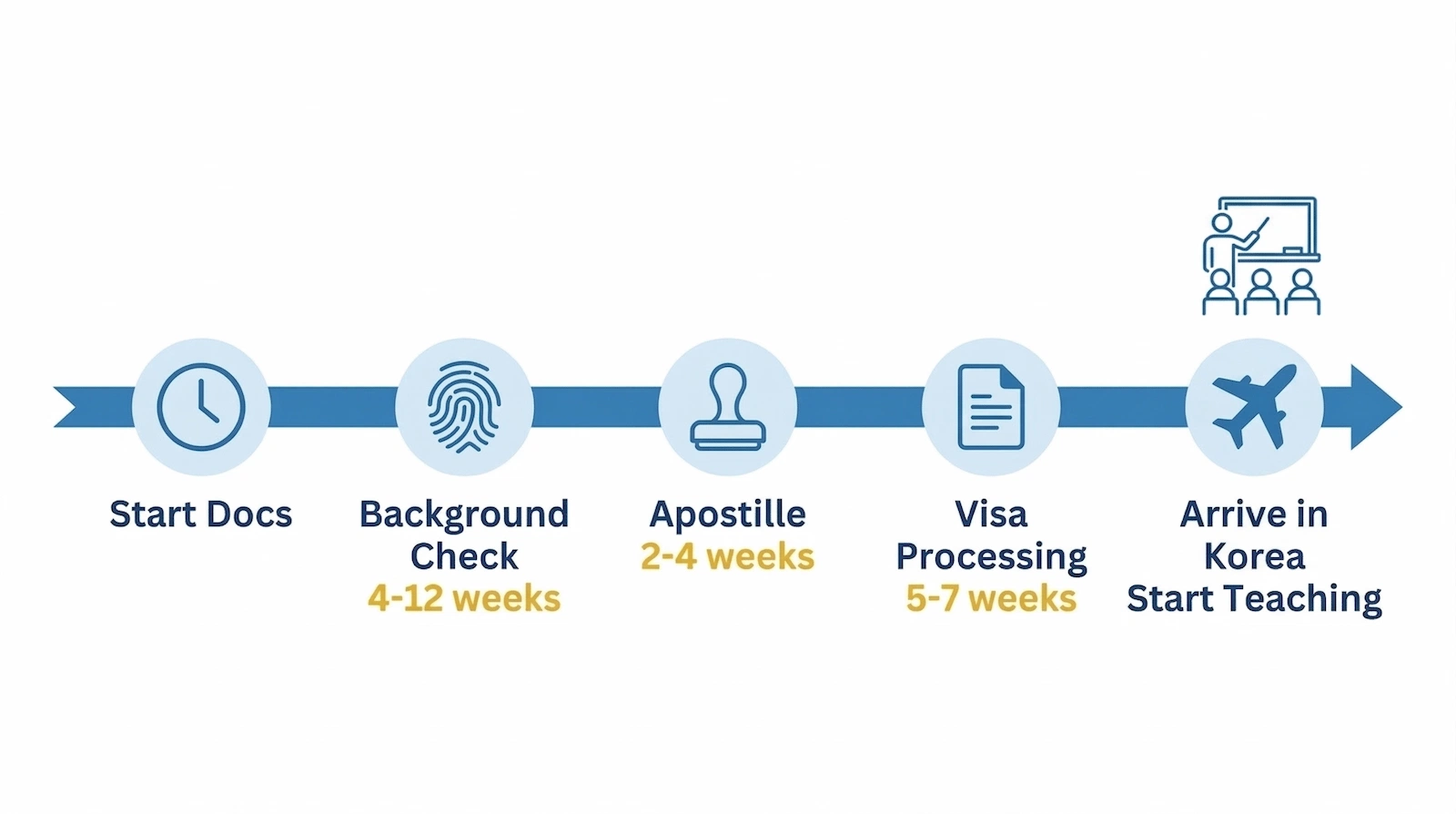
Start gathering documents two to three months before you want to begin teaching. Schools typically recruit about two months ahead of a start date, and the E-2 visa itself takes several weeks to process once your documents are in hand. Count backwards from your target month and you'll see why early movers get the best positions. Our E-2 visa process guide walks through the full timeline.
What documents will I actually need?
At minimum: a passport valid well beyond your contract, your apostilled degree, an apostilled national criminal background check, passport photos, and sealed transcripts (for some schools). Requirements vary slightly by nationality and school, so confirm your exact list with your recruiter before you pay for anything.
Checkpoint 2Reading your contract
This is the stage teachers worry about most. A Korean teaching contract can contain clauses that look alarming at first glance — repayment clauses, deposits, deductions. Most are standard, and here's the part nobody tells you: Korean labor law sits above every clause in your contract.
Under Article 15 of Korea's Labor Standards Act, any contract term that falls below the legal minimum is void for that part — and the legal standard applies instead. A clause can't strip you of a right the law guarantees, even if you signed it. That single principle answers most contract worries before they start.
My contract says I repay airfare (and recruiting fees) if I leave early — is that enforceable?
Partly — and it's worth knowing which part. If you leave before finishing your contract for your own reasons, the school can ask you to repay the actual airfare it paid to fly you over, and that is lawful: recovering a real, documented cost isn't a penalty, it's reimbursement, and Korean courts treat it that way as long as the amount is the genuine cost and the contract length is reasonable. Public-school programs like EPIK work the same way. What the law does not allow is a fixed penalty for quitting, or extra "recruiting" and admin charges piled on top of the real airfare — Article 20 of the Labor Standards Act prohibits predetermined penalties precisely so workers aren't trapped. And of course, complete your 12-month contract and none of it applies. If a clause is unclear, ask your recruiter to spell out exactly when — and how much — it could ever cost you.
There's a "housing management deposit" — what's it for, and do I get it back?
A housing management deposit covers practical risks like unpaid utility bills or damage to the apartment, and it's normally returned at the end of your contract if there are no outstanding bills or damage. Ask for the exact amount and the return conditions in writing so there are no surprises on the way out.
The contract mentions salary deductions for lateness — should I worry?
Punctuality clauses are common, but your wages are protected: Korean law treats pay as something that must be paid in full except where the law specifically allows a deduction, so a school can't dock your salary arbitrarily. In well-run academies these clauses are rarely used for ordinary lateness — they exist for serious or repeated issues. Ask the school how the clause is actually applied day to day.
Training days are at a reduced salary — is that paid time?
Yes — your training days are paid, at the rate stated in your contract, and they're usually just a few days spent learning the school's system and observing before you teach full classes. A short reduced-rate orientation is generally acceptable, with one floor: if the figure ever fell below Korea's minimum wage for the hours you actually work, the minimum wage would apply — because, again, the law overrides the clause.
This is general information for teachers, not legal advice. Contracts differ, and your individual situation can too. The point isn't to argue every clause — it's to understand them, ask good questions, and know the law is on your side.
Checkpoint 3The visa application form
Once your school's sponsorship is approved, you'll get a Visa Issuance Confirmation number and complete a visa application form at your Korean consulate or visa center. Teachers always hit the same few fields.
What do I put for "status of stay"?
E-2 — that's the foreign language instructor (teaching) visa status. Your Visa Issuance Confirmation will show the exact code, often written as E-2-1. If a field asks for the confirmation number or its validity date, that's all on the same approval notice.
It asks for an address and phone number in Korea, but I don't have one yet. What do I use?
Use your school's address and phone number. Until you arrive and set up your own place and phone, the school's details are what go in the "details of visit" and contact fields — the same address you used when shipping your documents. It's completely normal not to have your own Korean address at this stage.
It wants the inviting organization's business registration number — where do I get that?
From your school, through your recruiter. The "details of invitation" section asks for the school's business registration number; just request it. A good recruiter will hand it to you the moment you start the form.
What goes in the funding or expenses section?
Your salary, plus the airfare reimbursement your school provides where relevant. You're simply showing you'll be financially supported during your stay — your contract is your evidence.
Required fields differ slightly between Korean consulates and visa centers around the world. Always fill in the exact form your recruiter sends you (not a generic one you find online), and when a field is unclear, ask before you submit. Our guide to applying at the Korean consulate walks through it.
Checkpoint 4Landing & your first weeks
The questions don't stop when you board — but most arrival questions share one answer: you handle them in person, in your first week or two in Korea. Here's the short version of what teachers ask before they fly. (For the full play-by-play once you land, we have a dedicated guide — linked below.)
What are my real upfront costs, and when's my first paycheck?
Budget for three things in your first weeks. Your first salary arrives on the school's regular payday, which can be several weeks after you start — so land with a cushion.
| First-weeks cost | Rough amount | Notes |
|---|---|---|
| Airport transport | ~₩15,000 | An airport limousine bus is usually the easiest way to your city; buy the ticket on arrival at the booth or kiosk — card or cash. |
| In-Korea medical check (for ARC) | ~₩80,000–150,000 | Not covered by insurance; the school doesn't pay it. Hospitals take card or cash. Details here. |
| ARC government fee | ~₩30,000–35,000 | Bring cash; set by immigration and subject to change; current schedule at hikorea.go.kr. |
Can I book the medical check and ARC appointment before I arrive?
No — both happen in Korea, after you arrive. The health check must be done at a designated Korean hospital (a checkup from your home country won't be accepted), and the Alien Registration Card is registered through hikorea.go.kr once you're in the country. Most teachers complete both within their first few weeks, since the ARC is what unlocks a Korean bank account, a phone contract, and home internet.
Will my apartment be furnished, and how do utilities work?
School-provided studios typically come with the basics — a bed and bedding, refrigerator, washing machine, air conditioner, and a basic kitchen set, usually with a stovetop. Electricity and water are normally on from the day you move in; internet often can't be installed until you have your ARC. Because the lease is usually in the school's name, you'll often pay utilities to the school, which settles with the providers — but confirm the exact arrangement, since schools handle this slightly differently.
What about dress code and tattoos?
Smart casual is the norm at most academies. Visible tattoos are usually fine as long as they're covered during school hours — attitudes are relaxing, but covering up at work is still the safe default. Policies vary by school, so it's a fair question to ask before you arrive rather than on day one.
Your first week has its own rhythm — SIM card, transport apps, banking, school orientation, and admin. We mapped it out step by step in your first week teaching in Korea.
The real takeaway
A good recruiter answers every one of these questions before you fly — that's the entire job. The teacher whose questions filled this guide didn't ask them because she was difficult; she asked because she was prepared, and being prepared is exactly what makes the move to Korea feel easy instead of frightening.
If you're stuck on a form, unsure about a clause, or just want someone to walk the timeline with you, that's what we're here for. We never charge teachers a placement fee — schools pay all fees — so asking us costs you nothing but the time it takes to write the email.
This guide is general information for teachers, not legal advice. Visa requirements, fees, and contract terms change and can vary by consulate, school, and nationality — confirm specifics with your recruiter and official sources (hikorea.go.kr, your Korean consulate) before acting.