

Leaving Korea · Money & Pension
A slice of your salary has been leaving your paycheck every month for the National Pension. When you fly home for good, much of it can come back to you — in one payment, plus your employer’s matching half and interest. But not every passport qualifies, and the rules changed in 2026.
This guide is the departure checklist for your pension: who can actually claim the lump-sum refund (반환일시금), how much lands in your account, the documents you need, and how to walk out of Incheon with the cash in hand on the day you leave.
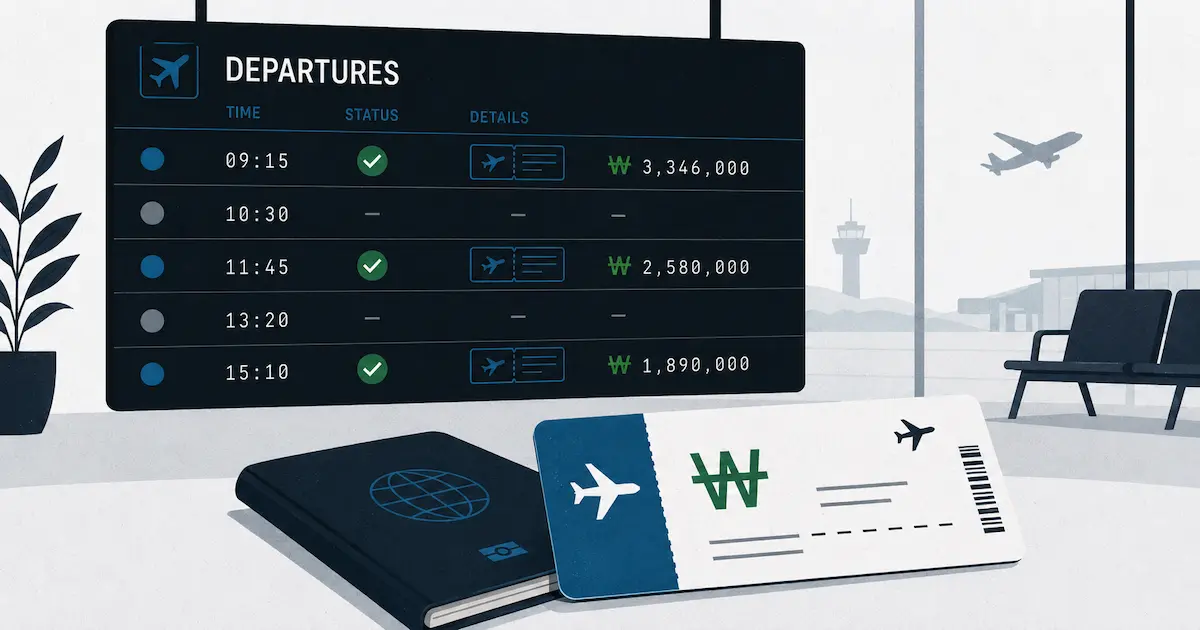
| United States | AGREEMENT | ✓ CLEARED |
| Canada | AGREEMENT | ✓ CLEARED |
| Australia | AGREEMENT | ✓ CLEARED |
| United Kingdom | REFUND EXCLUDED | ✗ NOT CLEARED |
| Ireland | REFUND EXCLUDED | ✗ NOT CLEARED |
| New Zealand | REFUND EXCLUDED | ✗ NOT CLEARED |
Reading the board: “Cleared” means you can claim a cash lump-sum refund when you leave. “Not cleared” means the refund is off the table for that nationality — the full reasons are in section 02. South African teachers are a separate case (usually exempt from paying in at all); more on that below.
What the lump-sum refund actually is
Every foreign teacher enrolled in the National Pension Scheme contributes a percentage of their monthly salary, and the employer pays a matching amount on top. That builds a balance in your name, held by the National Pension Service (NPS) — Korea’s government pension body.
The lump-sum refund (반환일시금) returns that balance to you in a single payment when you can no longer stay in the scheme — in almost every teacher’s case, when the contract ends and you permanently leave the country.
Your pension refund is not your severance. One comes from the government, the other from your employer — and you can be owed both.
Severance pay (퇴직금) is roughly one month’s salary per year worked, paid by your employer. The pension refund comes from NPS and is built from pension contributions. Collect both before you go. For how each one fits into your overall numbers, see our guide on how much you can save teaching in Korea.
Who can claim it — by nationality
This is the part that decides everything. Korea pays the refund to foreigners on one of two grounds: a social security agreement with your home country that includes the refund, or reciprocity (your country gives Korean nationals an equivalent benefit). The board at the top shows where the main teaching nationalities land. Here is the “why” behind each verdict:
| Nationality | Refund | Why |
|---|---|---|
| USA | Yes | Social security agreement — equal treatment with Korean nationals, refund included. |
| Canada | Yes | Social security agreement — refund included. |
| Australia | Yes | Social security agreement — refund included. |
| UK | No | The UK–Korea agreement is written to specifically exclude the lump-sum refund. |
| Ireland | No | NPS does not pay the lump-sum refund to Irish nationals. |
| New Zealand | No | NPS does not pay the lump-sum refund to New Zealand nationals. |
What this means in practice:
- US, Canadian and Australian teachers can claim the full balance back as a lump sum on departure. This is the clean, straightforward case.
- UK, Irish and New Zealand teachers can’t pull the money out as a cash refund. These countries do have agreements with Korea, but those agreements cover pension totalization — counting your Korean contributions toward a pension back home — while leaving the lump-sum refund out. Useful in theory if you’ll reach pension age with combined credits; not the “cash on the way out” that US/Canada/Australia teachers get.
- South African teachers are usually exempt from paying in in the first place, so there is typically no pension line on the payslip — and therefore nothing to refund. (Health insurance is still deducted as normal.)
Eligibility lists can change, so confirm your own case on the official NPS — Foreigners and Lump-sum Refund page before you bank on it.
How much money you get back
Here’s the figure teachers underestimate. The refund is not just what came out of your paycheck — it returns the total contributions in your account, including your employer’s matching half, plus interest.
Under the 2026 pension reform (effective 1 January 2026), the contribution rate rose from 9% to 9.5% of monthly salary, split evenly between you and your employer:
Because both halves come back, you collect roughly double what you saw deducted — with interest added on top, calculated on the three-year fixed-deposit rate across your insured months.
Rough scale: if about ₩140,000/month left your salary for pension over a one-year contract, the refund reflects the full combined ~₩280,000/month, plus interest — a meaningful flight-home fund. Exact amounts depend on your reported salary and months paid.
As of July 2026, contributions are capped at a monthly salary of ₩6,590,000 (the ceiling is adjusted every July, up from ₩6,370,000), so nearly all teachers contribute on their full pay. The rate is scheduled to keep climbing 0.5 points a year toward 13% by 2033, so long-term teachers’ future refunds grow with it.
When to claim, and the 5-year deadline
You become entitled when you permanently leave Korea (or otherwise lose eligibility for the scheme). Most teachers file right at the end of their contract, as they head home for good. You have two timing options:
- Just before departure — file while still in Korea if you can prove you’re leaving within one month (a booked international ticket counts).
- After departure — file from your home country by mail or through an agent.
Don’t let it sit. If you don’t claim within five years of becoming entitled, the right normally expires.
Documents you need
Filing before you leave, at an NPS office in Korea, bring:
- The lump-sum refund application (available at the office)
- Your passport
- Your Alien Registration Card (ARC)
- A copy of your bank account details (bankbook copy) for the deposit
- Proof of departure within one month — typically a booked international flight ticket
Filing after you’ve already left is heavier: foreign documents usually need notarization plus an apostille (for Apostille Convention countries) or attestation by a Korean consulate, and non-Korean documents may need a notarized Korean translation. Filing before you fly is almost always simpler.
Three ways to file your claim
- In person at an NPS office before departure. The cleanest route: bring the documents above, file, and nominate a Korean or overseas account for the deposit.
- By post after departure. Mail the application, passport copy, bank-account proof, and an overseas remittance application, with documents authenticated as above.
- Through an agent. Once you’ve left, you can authorize someone in Korea to file for you with a power of attorney.
Collecting cash at Incheon Airport
The option most teachers never hear about: if you fly out of Incheon International Airport, you can collect your refund in cash (foreign currency) on departure day itself. To use it, you need to:
- Be eligible, and departing from Incheon within one month of applying.
- Make sure your employer has reported your resignation (loss of coverage) to NPS by the day before you fly — the step teachers most often miss. Confirm it with your school ahead of time.
- Be on a weekday flight within service hours (roughly mid-morning to midnight; not available on weekends, public holidays, or the last business day of December).
Payment is in foreign currency — 16 currencies including USD, EUR and JPY (no Korean won). The day-of process runs in three stops:
| Stop | Where | What happens |
|---|---|---|
| 1 | NPS Incheon Airport Center (Terminal 1) | Show your passport and the Certificate of Application Acceptance from when you filed; receive a payment direction. Everyone goes to the Terminal 1 center, even if flying from Terminal 2. |
| 2 | Woori Bank currency exchange (before immigration) | Hand over passport and payment direction; receive a currency-exchange receipt. |
| 3 | Woori Bank booth, duty-free area (after immigration) | Show passport and receipt; collect your refund in cash. |
Always nominate a backup bank account when you apply, in case airport payment isn’t available on your travel day or an adjustment is needed later.
Mistakes that cost teachers money
- Assuming everyone gets a refund. Check the board first — UK, Irish and NZ teachers especially should confirm before counting on it.
- Skipping the resignation report. If your employer hasn’t reported your loss of coverage in time, airport cash pickup won’t work. Line it up with your school before your last day.
- Closing your Korean bank account too early. Keep one open, or have a clear overseas-remittance plan, so the refund has somewhere to land.
- Leaving it for “later.” The five-year clock is real, and chasing it from abroad with notarized paperwork is far more painful than filing before you board.
- Forgetting your severance. Collect your 퇴직금 from your employer too — separate money, separate process.
Questions teachers ask
Can British teachers get a Korean pension refund?
Generally no. UK nationals contribute while working in Korea, but the UK–Korea agreement specifically excludes the lump-sum refund. Contributions can count toward pension totalization between the two countries, but you can’t withdraw them as cash on departure.
Do South African teachers pay into the pension?
Usually not. South Africa is generally exempt from the contribution requirement, so most South African teachers see no pension deduction at all — and so have nothing to refund. Health insurance is still deducted normally.
Do I really get my employer’s contributions too?
Yes. The refund returns the total in your account — your share and your employer’s matching share — plus interest. That’s why it works out to roughly double your own deductions.
How fast does the money arrive?
Cash at Incheon Airport is same-day, on departure. Bank transfers and overseas remittance typically take a few weeks after your claim is accepted — plan in weeks, not days.
What if I’m staying in Korea and just switching jobs?
The refund is for people permanently leaving. If you’re changing employers but staying, your pension simply keeps accumulating. For the visa side of switching jobs, see our E-2 visa extension guide.
Next departure board
Wrapping one contract is the best time to line up the next.
OK Recruiting matches native English teachers with vetted hagwon and school positions across Korea — with full visa and paperwork support from first email to first day.
See current teaching jobs →General information for English teachers in Korea, reflecting National Pension Service rules current as of 2026. Eligibility, rates and procedures can change and individual cases vary — confirm your own situation with the National Pension Service before acting. OK Recruiting is not a tax or legal advisor.