


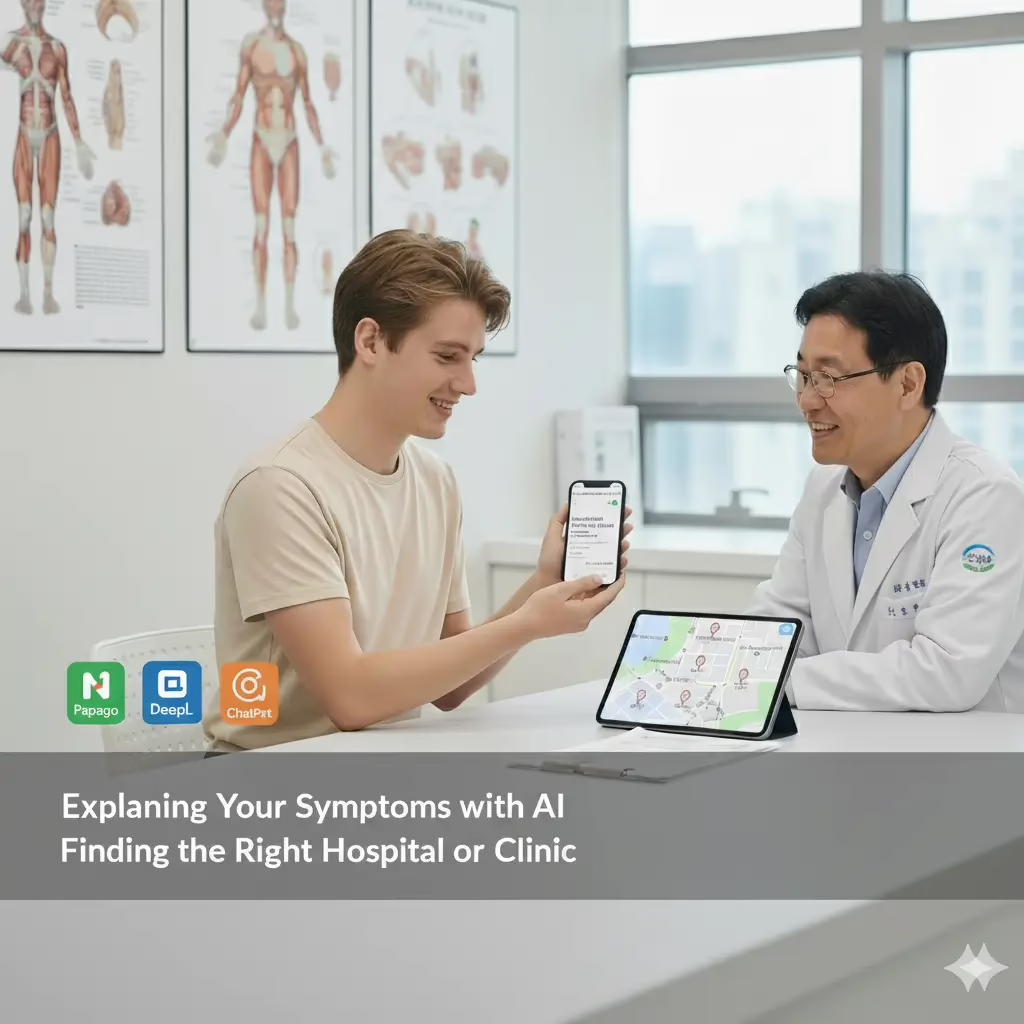
It’s 9 p.m., your throat is on fire, and the pharmacist doesn’t speak English. In Korea, the real obstacle to getting care usually isn’t the healthcare — it’s the language. Your phone can bridge that gap, if you know which tools to use and where they stop.
A practical guide to handling healthcare in South Korea with translation and AI tools, for foreign English teachers, from OK Recruiting (Korea-based, since 2006). Current as of 2026 — general information, not medical advice.
Your co-pilot toolkit
A small set of free apps covers almost every clinic or pharmacy situation. Install these before you need them:
| Tool | What it does | Use it for |
|---|---|---|
| Papago | Korean-optimized translator (papago.naver.com): text, voice, conversation mode, and camera translation | Reading a medicine label; back-and-forth at the pharmacy counter |
| Google Translate | Camera/live image translation and conversation mode, with an offline Korean pack | Translating an intake form or a sign for the right department |
| ChatGPT | Any LLM (chatgpt.com): turns vague symptoms into clear, translatable text and explains a doctor’s instructions | Describing symptoms; decoding a Korean prescription (see limits below) |
| E-Gen | Official finder (e-gen.or.kr) for open ERs, hospitals, and pharmacies right now, including nights and holidays | Finding an open pharmacy or ER at 10 p.m. or on a holiday |
| Naver / Kakao Map | Search “문 연 병원 / 문 연 약국” (open hospital / pharmacy) with hours and one-tap call | The fastest everyday way to find a nearby open clinic or pharmacy |
The workflow: symptoms in, instructions out
Before the visit — describe your symptoms
- List the details in an LLM: what hurts, where, how long, severity, any fever/temperature, allergies, current medications, and chronic conditions.
- Ask it to write a short, polite message in Korean for a doctor — and keep the English version too.
- Screenshot both so you can show the Korean text even with no signal.
At the clinic or pharmacy — bridge the conversation
- Show the Korean text, then use Papago conversation mode (or Google Translate) for the back-and-forth.
- Point the camera at anything printed — forms, labels, signs — for instant translation.
After — decode the prescription
- Photograph or type the Korean prescription or instructions and ask the LLM to translate and explain each item, dose, timing (before or after meals), and warnings.
- Confirm anything about dose, allergy, or interaction with the pharmacist directly — they are the authority, and Korean pharmacists are highly trained.
Human backup: the helplines that matter
Apps are for routine visits. For emergencies and anything serious, a real person is better — and several are free and multilingual.
| Call | Run by | For |
|---|---|---|
| 119 | Fire & EMS | Ambulance and emergencies. Say “English” to be bridged into a live 3-way interpreter call (about 19–20 languages, 24/7) |
| 1339 | KDCA (disease control) | Non-emergency health advice and “what should I do” guidance, 24/7 — also reachable via KakaoTalk. Not for summoning an ambulance. |
| 1330 | Korea Travel Hotline | 24/7 help line that interprets and can route you to 119 or the right service |
| 1588-5644 | BBB Korea | Free volunteer phone interpretation, on demand, ~19–20 languages, 24/7 |
| 1345 | Immigration | Visa, ARC, and residence questions (relevant for insurance and status) |
One correction worth making: 119’s foreign-language support is delivered by human interpreters, not AI. AI interpretation is being piloted in some regions, with a national system planned for 2027–2029 — but today, a real person bridges the call.
What it costs: NHIS and co-pays
If you’re teaching on a contract of six months or more, National Health Insurance (NHIS) is mandatory, and your school splits the premium with you (together roughly 4% of your gross salary). After NHIS, a neighborhood-clinic co-pay is usually about ₩4,000–10,000, with medication a few thousand won more. Bring your ARC to register and to visits. Note that the separate E-2 visa medical exam is not covered by NHIS. For the full breakdown, see OK Recruiting’s guides to Korean health insurance (NHIS).
Where AI stops — and a human takes over
Use AI to communicate, not to diagnose
- AI is not a doctor. It can mistranslate a drug name or dose, and it can’t examine you. Use it to bridge language, not to decide whether to take a medication.
- Medical translation is imperfect. For surgery, hospitalization, or a chronic condition, use a real interpreter (BBB Korea, or in Seoul the Seoul Global Center’s medical interpretation service), not an app.
- Protect your privacy. Don’t paste your full name or ARC number into a chatbot.
- Emergencies override everything. When in doubt, call 119.
Frequently asked questions
Is calling 119 free, and can I get an English interpreter?
Yes — 119 (ambulance and fire) is free. Say “English” and the operator connects a live 3-way call with an interpreter (about 19–20 languages, 24/7). It’s human interpreters today; AI interpretation is being piloted but isn’t the nationwide standard yet. Use 119 for real emergencies.
If it’s not an emergency, what number gives medical advice in English?
Call 1339, the KDCA health line — 24/7, multilingual, and reachable through KakaoTalk — for health questions and guidance on what to do. The 1330 Korea Travel Hotline (also 24/7) can interpret and route you as well. Save 119 for genuine emergencies.
Can I use ChatGPT or Papago to talk to a Korean doctor?
For routine visits, yes — use an LLM at chatgpt.com to phrase your symptoms in Korean and to translate the doctor’s instructions, and Papago (papago.naver.com) or Google Translate for live conversation and camera translation. But AI is not a doctor or a certified medical interpreter: for anything serious, use a human interpreter, and confirm any medication with the pharmacist.
How do I find a hospital or pharmacy open right now, at night or on a holiday?
Use the E-Gen app or e-gen.or.kr (official) to see open ERs, hospitals, and pharmacies with live ER capacity, or search “문 연 병원 / 문 연 약국” in Naver Map or Kakao Map. 1339 or 1330 can also point you to an open facility.
Will my Korean health insurance cover the visit, and how much will I pay?
If you’re on a contract of six months or more, NHIS is mandatory and your school splits the premium with you (~4% of gross salary total). After insurance, a neighborhood-clinic co-pay is usually about ₩4,000–10,000. Bring your ARC. The separate E-2 visa medical exam is not covered by NHIS.
Is there free interpretation by a real person, not just an app?
Yes — BBB Korea (1588-5644) offers free volunteer phone interpretation, 24/7, in about 19–20 languages (phone only, no on-site interpreter). In Seoul, the Seoul Global Center runs a medical referral service and in-person medical interpretation for surgeries and hospitalizations. 1330 and 119 also bridge in interpreters while you’re on the phone.
Sources: 1339 health line — Korea Disease Control and Prevention Agency (KDCA); 119 interpretation and helplines — National Fire Agency and BBB Korea; app details — Naver Papago, Google Translate, and E-Gen (National Emergency Medical Center). As of 2026.
Disclaimer: General information, not medical advice. AI translation can be inaccurate; confirm medications and any serious concern with a doctor or pharmacist, and call 119 in an emergency.